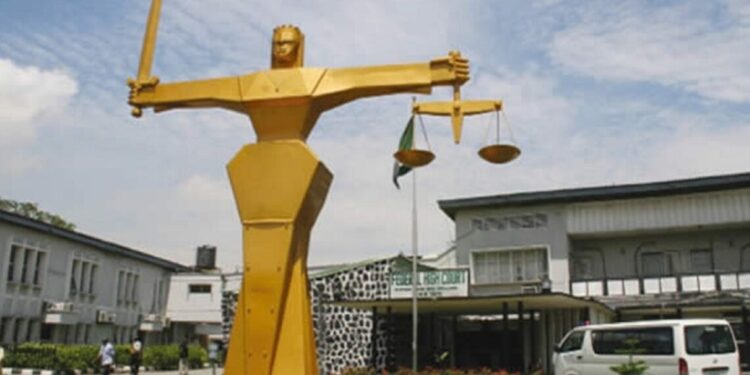
The Federal High Court in Abuja has nullified key aspects of the 2027 election timetable issued by the Independent National Electoral Commission (INEC), ruling that the electoral body exceeded its statutory powers.
Justice Mohammed Umar delivered the judgment in a suit filed by the Youth Party against Independent National Electoral Commission, challenging provisions of its Revised Timetable and Schedule of Activities for the 2027 general elections.
The party had argued that INEC imposed restrictive deadlines on political parties for primaries and other pre-election activities, in violation of the Electoral Act, 2026.
In his ruling, Justice Umar held that INEC does not have the legal authority to determine timelines for the conduct of party primaries or to shorten statutory periods prescribed under the Electoral Act.
The court also ruled that INEC cannot lawfully reduce or alter timelines relating to the submission of candidate particulars, candidate withdrawal and substitution, or publication of final candidate lists.
Specifically, the judge stated that political parties are entitled to the full statutory period provided under the Electoral Act, including the 120-day window for submission of candidate particulars and the 90-day period for withdrawal and substitution of candidates.
He further held that INEC lacks the power to publish the final list of candidates before the minimum 60-day period required by law, or to impose campaign deadlines inconsistent with statutory provisions.
Justice Umar set aside portions of the INEC timetable that imposed deadlines for party primaries and related pre-election activities, declaring them inconsistent with the Electoral Act, 2026.
The court also nullified provisions that fixed earlier deadlines for campaign activities and submission of party membership registers where they conflicted with the law.
The ruling effectively invalidates several key components of INEC’s revised election calendar, which had earlier set presidential and National Assembly elections for January 16, 2027, and governorship elections for February 6, 2027.
Under the now-partially voided timetable, party primaries were scheduled to run from April 23 to May 30, 2026, while campaigns were to begin in August and September 2026 for various offices.
The court’s decision is expected to have significant implications for Nigeria’s election planning process, particularly the balance of authority between INEC and political parties under the Electoral Act, 2026.
INEC had earlier justified its revised timetable by citing the repeal of the Electoral Act, 2022, and the enactment of the Electoral Act, 2026, which introduced updated election timelines.
The commission had also projected a budget of N873.78 billion for the 2027 general elections, alongside N171 billion for its 2026 operations, reflecting the scale of national electoral administration.
The case highlights ongoing legal and institutional debates over electoral scheduling, party autonomy, and the limits of regulatory authority in Nigeria’s democratic process.