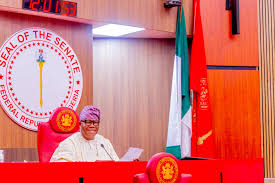
The Nigerian Senate has resolved to establish a joint ad hoc committee involving both the Senate and the House of Representatives to address the increasing cases of xenophobic attacks against Nigerians in South Africa.
The committee, which will be led by the Chairman of the National Assembly, is expected to embark on a fact-finding and diplomatic mission to South Africa. The objective is to engage relevant stakeholders and explore lasting solutions to the recurring crisis.
As part of its mandate, the delegation will visit the South African Parliament to formally convey Nigeria’s strong concerns and dissatisfaction over the reported attacks on its citizens.
The Senate also resolved to send a formal correspondence to the Speaker of the South African Parliament while also inviting Nigeria’s Minister of Foreign Affairs to brief lawmakers on the outcome of diplomatic engagements.
In addition, the upper chamber adopted a resolution sponsored by Senator Simon Lalong, calling for a review of agreements reached during a 2019 bilateral meeting between Nigeria and South Africa to ensure full implementation.
Tensions rose during deliberations after Senator Adams Oshiomhole suggested the possible revocation of operational licences of major South African companies in Nigeria, including MTN and DSTV. However, the proposal was ruled out on procedural grounds.
The Senate President stressed the importance of diplomacy in resolving the crisis, stating that economic retaliation would not be the preferred approach. He, however, emphasized that the reported attacks are being treated with urgency and seriousness.
The resolutions followed a motion of urgent national importance moved by Senator Bassey, titled: “Intensifying Xenophobic Persecution of Nigerians in South Africa and Ghana: A Call for Urgent National, Diplomatic and Humanitarian Action to Defend the Dignity, Safety and Honour of Nigerian Citizens.”
Lawmakers were divided during debate over whether the motion should be considered behind closed doors, with Senator Aliero calling for a closed session. The proposal was opposed by Senator Ningi and others, who insisted on open deliberations.
Senators also expressed concern over rising fear, psychological trauma, and alleged profiling of Nigerians abroad, noting that many citizens are increasingly being targeted based solely on nationality.
The chamber later observed a minute of silence in honour of Nigerians who lost their lives in the attacks in South Africa.