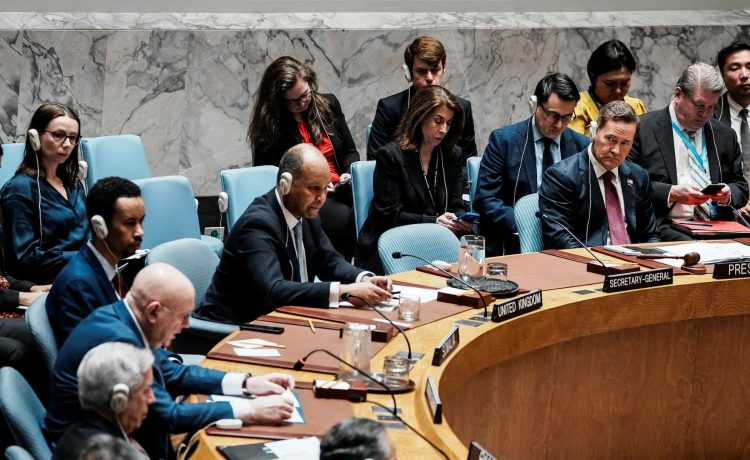
The United States and its Western allies clashed with Russia and China on Thursday at the United Nations over Iran’s nuclear program, as Washington sought to justify the war it launched on Iran two weeks ago.
During a meeting of the 15-member U.N. Security Council, chaired by the U.S. this month, Russia and China attempted to block discussion on the 1737 Committee, which oversees and enforces U.N. sanctions on Iran. Their efforts were overruled, with the motion passing 11-2 and two abstentions.
U.S. Ambassador to the U.N., Mike Waltz, accused Moscow and Beijing of trying to protect Tehran by obstructing the committee’s work.
“All member states of the United Nations should be implementing an arms embargo against Iran, banning the transfer and trade of missile technology, and freezing relevant financial assets,” Waltz said.
He added that the U.N. measures were narrowly focused on countering Iran’s nuclear, missile, and conventional arms programs, as well as its ongoing support for terrorism. Waltz said China and Russia opposed a functional sanctions committee because they want to maintain defense cooperation with Iran, now prohibited under U.N. provisions.
Waltz also cited the International Atomic Energy Agency (IAEA), which last week reported that Iran is the only non-nuclear-weapon state to have accumulated uranium enriched up to 60 percent and had denied IAEA access to the stockpile.
In response, Russia’s U.N. Ambassador Vasily Nebenzya accused the U.S. and its allies of exaggerating threats to justify military action against Tehran. “This was done in order to undertake yet another military venture against Tehran and to ensure great escalation of the situation in the Middle East and beyond,” he said.
China’s representative, Fu Cong, labelled Washington as the “instigator” of the crisis, claiming the U.S. had undermined diplomatic negotiations by using force against Iran.
Iran’s U.N. ambassador, Amir Saeid Iravani, told reporters that Iran’s nuclear program “has always been exclusively peaceful” and vowed not to recognize any sanctions enforcement.
U.S. President Donald Trump has cited Iran’s nuclear program to justify military strikes, claiming that Iran would have acquired a nuclear weapon within two weeks had the U.S. not targeted three key nuclear sites in June—a claim reportedly not supported by U.S. intelligence assessments.
Britain and France told the Security Council that sanctions were necessary due to Iran’s failure to resolve concerns about its nuclear program. France added that the IAEA could no longer guarantee the peaceful nature of Iran’s nuclear activities, noting that Tehran’s enriched uranium stockpile is sufficient for up to 10 nuclear devices.