Colombia’s presidential election is set for a decisive runoff on June 21 after no candidate secured the majority required to win outright in the first round of voting held on Sunday.
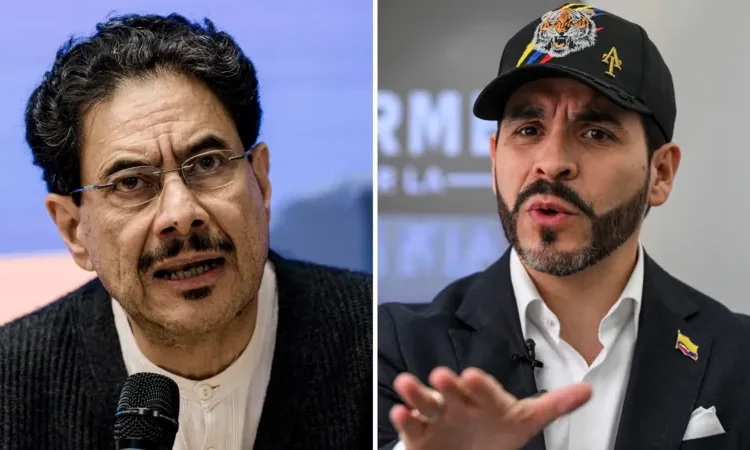
Right-wing candidate Abelardo de la Espriella emerged narrowly ahead of left-wing senator Iván Cepeda, setting up a highly polarised contest between two candidates offering sharply different visions for the country’s future.
Official results showed De La Espriella received 43.7 per cent of the vote, while Cepeda secured 41 per cent, with nearly all ballots counted.
Neither candidate crossed the 50 per cent threshold required to avoid a second-round election.
The campaign was marked by significant violence and security concerns, including drone attacks, kidnappings, homicides, and the assassination of a presidential candidate during a campaign rally last year.
The runoff is expected to focus heavily on how Colombia should address its long-running internal armed conflict, which has intensified in recent years despite previous peace efforts.
Following the results, De La Espriella celebrated his first-round lead and framed the runoff as a battle against what he described as authoritarian tendencies.
“We will defeat tyranny and absolutism,” he said, describing the outcome as a victory for Colombians who believe in self-reliance and economic freedom.
Cepeda, however, adopted a cautious approach and declined to make extensive comments until the vote count had been formally verified by electoral authorities.
The race received another boost for De La Espriella after moderate conservative candidate Paloma Valencia, who finished third with less than seven per cent of the vote, endorsed his candidacy.
Meanwhile, Colombian President Gustavo Petro, who publicly backed Cepeda, questioned the preliminary results and said he would wait for the final review by electoral judges before accepting the outcome.
Petro alleged voting irregularities and claimed that hundreds of thousands of votes had been added to the tally, although he did not provide evidence to support the allegations.
Electoral authorities rejected concerns about the integrity of the process and stated that voting had proceeded normally and safely across the country.
Cepeda is widely known for his role in the peace negotiations that led to the landmark 2016 agreement between the Colombian government and the FARC guerrilla movement.
He has been closely associated with President Petro’s “total peace” strategy, which prioritises negotiations and ceasefires with armed groups over large-scale military operations.
Supporters argue that dialogue remains the most sustainable path toward ending decades of violence, while critics contend that the approach has allowed criminal organisations to expand their influence.
During Petro’s administration, cocaine production reached record levels, armed group membership increased, and violence in border regions intensified, displacing tens of thousands of people.
Although the government has pointed to record drug seizures and economic growth, many security analysts have questioned the effectiveness of the current security strategy.
Cepeda has pledged to expand welfare programmes, pursue economic reforms, and increase land redistribution to victims of Colombia’s internal conflict if elected.
His opponent, De La Espriella, has campaigned on a law-and-order platform centred on a tougher military response to organised crime and insurgent groups.
The lawyer and businessman, popularly known as “El Tigre,” has called for closer security cooperation with the United States, expanded powers for the military, and stronger measures against drug cartels.
Among his proposals is the construction of 10 large prisons modelled on the hardline anti-crime policies implemented by Nayib Bukele in El Salvador.
De La Espriella has also pledged to reduce the size of government and pursue market-oriented economic reforms.
However, his candidacy has attracted controversy over previous legal work for high-profile clients, including associates of the Venezuelan government and individuals convicted of financial crimes.
He has defended his record, arguing that representing controversial clients is part of his professional duty as a lawyer, while critics have questioned the implications of those associations.
With Colombia deeply divided over issues of security, economic policy, and governance, the June 21 runoff is expected to be one of the most consequential elections in the country’s recent history.
The outcome will determine whether Colombia continues with the policies associated with President Petro’s administration or shifts toward a more conservative and security-focused approach under De La Espriella.