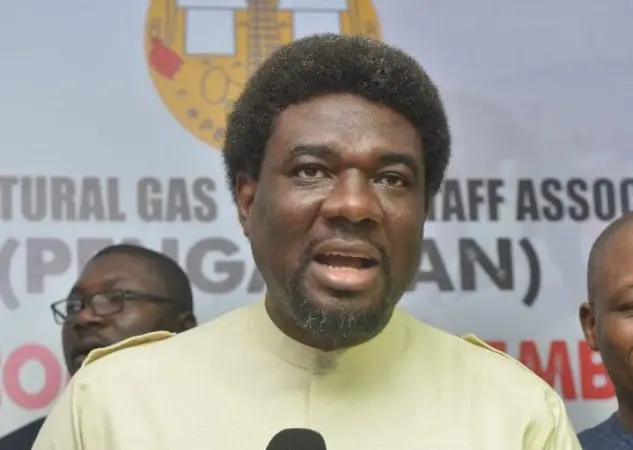
President of the Trade Union Congress of Nigeria (TUC), Festus Osifo, has called on the Federal Government to urgently address the value of the naira, insisting that wage increases alone will not resolve the economic hardship facing Nigerian workers.
Speaking during an appearance on Channels Television’s The Morning Brief, Osifo argued that the Nigerian currency is significantly undervalued and must be strengthened alongside any discussions on minimum wage adjustments.
He said both issues must be tackled simultaneously to meaningfully improve workers’ purchasing power.
“It is a double-edge approach. Even as we are fixing the value of the naira, we could also be having conversations around the minimum wage. They are not independent,” he said.
Osifo stressed that even a hypothetical increase in the minimum wage to ₦1 million would be ineffective if inflation and currency depreciation persist.
“You can come today and say that the Nigerian minimum wage is ₦1 million, but what is actually the value of that ₦1 million? Can it actually purchase anything meaningful?” he asked.
He noted that the current national minimum wage, signed into law at ₦70,000 in 2024 by President Bola Tinubu after negotiations with labour unions, has already been eroded by inflation and rising living costs.
Osifo added that external economic shocks, including recent global oil price movements, have worsened domestic inflation and further weakened the naira despite Nigeria’s status as an oil-producing nation.
According to him, the rising cost of fuel, transportation, and basic goods continues to reduce real incomes and deepen hardship for workers across the country.
He called for a more holistic economic approach that addresses currency stability, wage structure, and broader structural challenges simultaneously.
“So, if you don’t fix the fundamentals and you are just talking about minimum wage alone, it may not necessarily have the right purchasing power that it ought to have,” he said.
Osifo also urged policymakers to strengthen labour protections, address wage disparities, and curb the growing trend of casualisation in the workforce.
He reiterated that sustainable economic reform must prioritise workers’ welfare, insisting that improving the naira’s value is central to restoring dignity to labour in Nigeria.