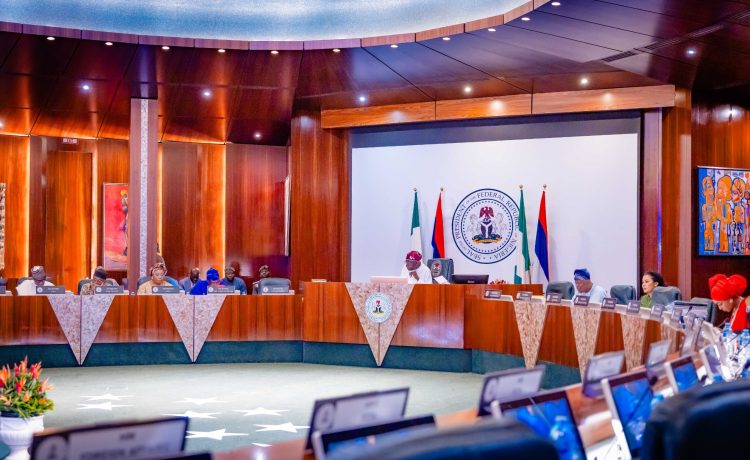
The Federal Executive Council (FEC) has approved $2.99 billion for major rail projects in Lagos, Kano, and Kaduna as part of efforts to expand Nigeria’s urban transport infrastructure and stimulate economic development.
The Minister of Finance and Coordinating Minister of the Economy, Taiwo Oyedele, disclosed the approval on Thursday following the Council’s meeting, confirming that contracts have been awarded for three key rail initiatives.
According to him, the projects include the Lagos Green Line Rail Project (Phase 1A), the Kano Metro City Rail Project, and the Kaduna State Light Rail Project.
“The Federal Executive Council today approved the award of contracts for three transformative rail projects. One is the Lagos Green Line Rail Project Phase 1A. The second is the Kano State Metro City Rail Project. And the third is the Kaduna State Light Rail Project,” Oyedele said.
He explained that the funding structure aligns with the federal government’s capital expenditure plans for 2025 and 2026. The 2025 CAPEX cycle has been extended to June, while the remaining funding requirements have been captured in the 2026 fiscal framework.
Oyedele noted that Lagos, Kano, and Kaduna were prioritised due to their strategic economic importance, stressing that investments in high-impact urban centres would improve capital budget execution and deliver strong economic returns.
He added that financing for the projects would be coordinated through the Ministry of Finance Incorporated (MOFI), alongside counterpart funding arrangements, in line with the government’s broader infrastructure development agenda.
The Lagos Green Line, a flagship project under the plan, is a proposed 68-kilometre rail corridor stretching from the Lekki Free Zone to Marina. It is designed to serve densely populated and commercially active areas such as Victoria Island, Lekki, and Ajah.
The project, valued at approximately $3 billion, will feature 17 stations and modern infrastructure, including pedestrian bridges, elevators, escalators, and a depot near Sangotedo. It is expected to operate eight-car trains at speeds of up to 100 km/h, with a three-minute headway and a capacity of about 35,000 passengers per hour per direction.
Phase 1 of the project will run from Lekki First Tollgate to Epe, while a later phase will include a water-crossing segment extending to Marina.
The Federal Government has already made provisions for counterpart funding, allocating N146.14 billion in the 2025 budget proposal and an additional N102.3 billion in the 2026 budget cycle through the Ministry of Transportation.
Despite the project’s scale, experts have raised concerns about station spacing and accessibility, warning that limited coverage in key areas like Victoria Island and wide gaps between stations could affect ridership. They have recommended additional stations and stronger integration with existing transport systems.
Following the FEC approval, Phase 1A of the Lagos Green Line is expected to commence in the near term.
Meanwhile, the rail projects in Kano and Kaduna build on earlier government plans to expand light rail systems in northern Nigeria. In July 2025, the Federal Government announced intentions to support rail development in the two states through public–private partnerships coordinated by MOFI.
Further reinforcing the initiative, about N250 billion was secured in September 2025 for rail development in both states, with N150 billion allocated to Kano and N100 billion to Kaduna.
The latest approvals signal a renewed push by the federal government to modernise urban transport systems and enhance connectivity across key economic hubs.