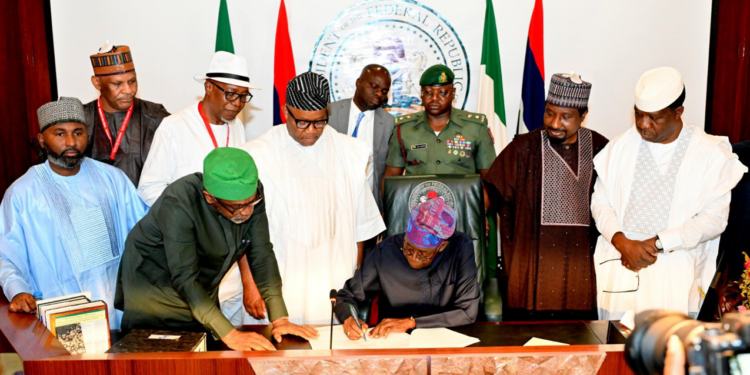
President Bola Tinubu has signed the 2026 Appropriation Bill into law, approving a total expenditure of N68.32 trillion for the 2026 fiscal year.
The President also assented to a separate amendment bill extending the implementation period of the capital component of the 2025 budget from March 31, 2026, to June 30, 2026, according to a State House statement issued on Friday.
Under the newly signed budget, N4.799 trillion is allocated for statutory transfers, while N15.8 trillion is earmarked for debt servicing. A further N15.4 trillion is set aside for recurrent expenditure, and N32.2 trillion will go into the Development Fund for capital projects.
The Presidency said capital expenditure accounts for about 50% of the total budget, describing it as a reflection of the administration’s focus on infrastructure development, national security, economic stability, and inclusive growth.
According to the statement, the spending plan is designed to balance statutory obligations, debt repayment, personnel costs, overheads, and investments aimed at improving productivity and living standards.
“Additionally, the President has assented to the Appropriation (Repeal and Enactment) (Amendment) Bill, 2026, which extends the implementation period of the capital component of the 2025 Appropriation Act from March 31, 2026, to June 30, 2026,” the Presidency stated.
The extension, it added, is intended to ensure full utilisation of previously approved funds, particularly for infrastructure and development projects already underway across the country.
Officials said the move would allow Ministries, Departments, and Agencies to complete ongoing projects, improve execution rates, and maximise value for public spending.
The 2026 budget was earlier presented to the National Assembly in December 2025, with a projected deficit of N23.85 trillion.
It outlines total revenue projections of N34.33 trillion against total expenditure of N58.18 trillion, with the deficit expected to be financed largely through borrowing.
Debt servicing remains a major component of spending, with N15.52 trillion allocated for that purpose. Key sectoral allocations include N5.41 trillion for defence, N3.56 trillion for infrastructure, N3.52 trillion for education, and N2.48 trillion for health.
The budget is based on assumptions including a $64.85 oil price benchmark, production of 1.84 million barrels per day, and an exchange rate of N1,400 to the dollar.
The government said the fiscal framework is designed to stabilise the economy while supporting growth through increased capital investment and targeted social spending.