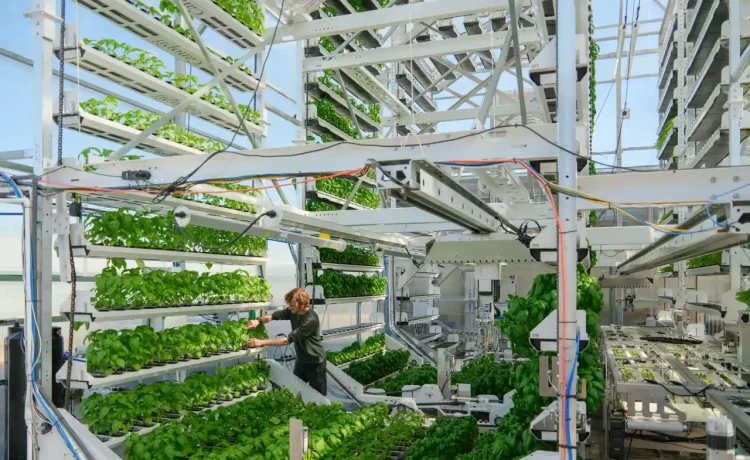
Agtech startup Canopii is developing autonomous robotic greenhouses designed to produce fresh crops with minimal water and human intervention.
The Portland, Oregon–based company builds greenhouse systems that can manage the entire farming process—from seeding to harvesting—without human labor.
Inspiration behind the startup
Founder David Ashton said the idea for the company came from years spent traveling between Sacramento and San Luis Obispo during California’s historic drought in the late 2000s.
During those trips, Ashton noticed vast lettuce farms thriving despite the dry climate, with crops shipped across the country. The experience inspired him to find ways to shorten produce supply chains and use resources more efficiently.
Autonomous farms with low resource use
Canopii’s robotic greenhouses can produce up to 40,000 pounds of produce annually while using just one water connection and occupying roughly the space of a basketball court.
The farms are currently designed to grow herbs and specialty greens such as baby bok choy and gai lan, also known as Chinese broccoli.
The greenhouse units are manufactured by GK Designs.
Building slowly after industry failures
Indoor farming once attracted massive investments, but several high-profile companies—including Bowery Farming and Plenty—later struggled financially.
Ashton believes Canopii’s slower growth strategy has helped the company avoid the pitfalls that affected many vertical farming startups.
Instead of relying heavily on venture capital, the company diversified its funding sources.
So far, Canopii has raised about $3.6 million, including $2.3 million in grants, such as funding from the National Science Foundation.
Plans for commercial expansion
After successfully developing a fully autonomous prototype farm, Canopii now plans to build its first commercial farm in downtown Portland.
The long-term vision includes franchising the greenhouse systems so businesses such as schools, restaurants, and casinos can grow fresh produce locally.
According to Ashton, the farms run on standard household-level electricity, making them flexible enough to install even in small spaces.
“You can literally put this in a backyard,” he said, highlighting the system’s efficiency in managing water and energy resources.