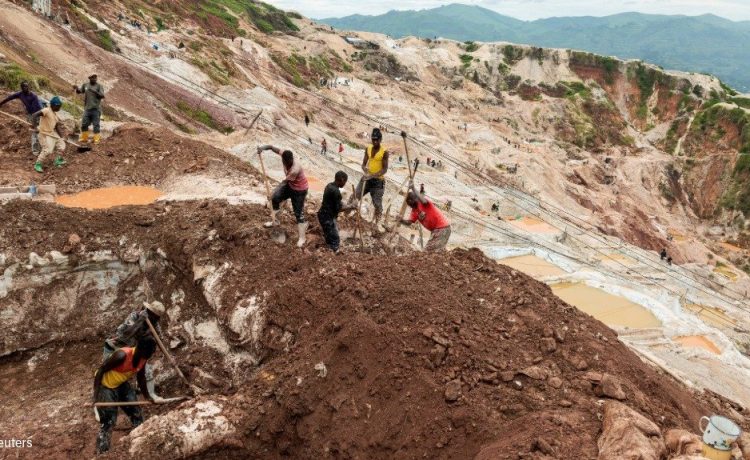
A landslide triggered by heavy rains has killed more than 200 people at the Rubaya coltan mine in eastern Democratic Republic of the Congo, authorities confirmed, with about 70 children among the victims.
The DRC Ministry of Mines said the disaster occurred amid persistent rainfall, sending earth and debris cascading down into mining pits where artisanal miners were working. Dozens of injured survivors were evacuated to medical facilities in Goma, the capital of North Kivu province.
However, the M23 rebel group, which has controlled the Rubaya mining area since 2024, disputed the government’s account of the tragedy. Fanny Kaj, a senior M23 official, claimed there had been “bombings” rather than a landslide and suggested that only five people died.
“I can confirm that what people are publishing is not true. There was no landslide; there were bombings, and the death toll isn’t what people are saying. It’s simply about five people who died,” Kaj told reporters.
But Ibrahim Taluseke, a miner who helped with recovery efforts, said he had personally helped retrieve more than 200 bodies from the site. “We are afraid, but these are lives that are in danger. The owners of the pits do not accept that the exact number of deaths be revealed,” he told the Associated Press.
A senior official from the Congo River Alliance–affiliated M23 faction, backed by Rwanda, told Reuters that operations at the site had been discouraged until the area could be secured and protective measures put in place. The official said heavy rains over the last few days were responsible for the collapse.
The Rubaya site was the scene of a similar deadly collapse in late January after heavy rain, which also killed more than 200 people. At that time, the Congolese government accused M23 of permitting unsafe, illegal mining without adequate safety protocols.
Rubaya is a critically important source of coltan, a mineral that yields tantalum, which is used in the manufacture of mobile phones, computers, aerospace components and gas turbines. The mine produces roughly 15 per cent of the world’s coltan supply.
The site has also been shortlisted under a minerals cooperation framework with the United States, as the Congolese government seeks to formalise and leverage its strategic mineral assets.
The latest disaster raises fresh concerns about safety standards in artisanal mining areas, the influence of armed groups over resource extraction, and the human cost of instability in mineral‑rich regions of the Congo.