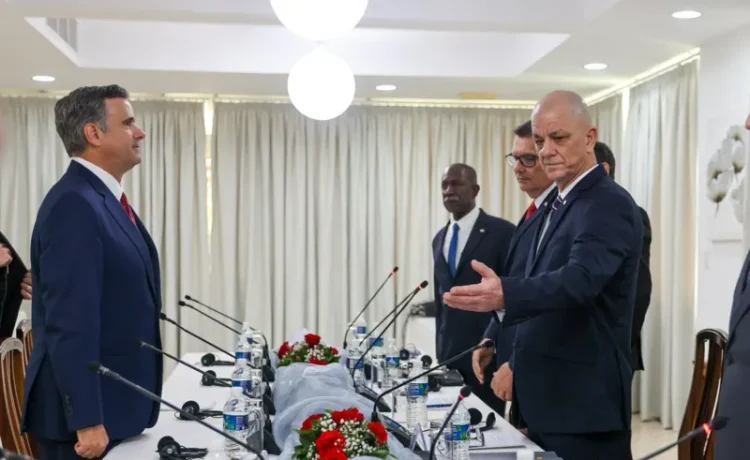
John Ratcliffe has met senior Cuban officials in Havana in a rare high-level engagement aimed at improving dialogue between the two countries, according to statements from both sides.
The meeting took place at Cuba’s Interior Ministry following the United States’ renewed offer of $100m (£74m) in aid to help ease the impact of a prolonged oil blockade that has severely affected the country’s energy supply and public services.
A Cuban government statement said the discussions were intended to strengthen communication channels and emphasized that Havana does not pose a threat to US national security.
A CIA official told CBS News that Washington is “prepared to seriously engage on economic and security issues, but only if Cuba makes fundamental changes.”
The talks reportedly included discussions on intelligence cooperation, economic stability, and regional security concerns, with US officials stressing that Cuba should not serve as a “safe haven for adversaries in the Western Hemisphere.”
Cuban Foreign Minister Bruno Rodríguez Parrilla said the country is open to reviewing the US aid proposal, though he questioned its structure and implementation.
He added that Cuba traditionally does not reject humanitarian assistance offered in good faith, but reiterated that the most effective solution would be lifting US economic and financial restrictions.
President Miguel Díaz-Canel has also criticized the blockade, arguing that easing sanctions would resolve the crisis faster than external aid packages.
The US State Department maintained that its assistance would be coordinated with independent humanitarian organizations, including the Catholic Church, to ensure distribution outside government channels.
Washington also warned that the decision now rests with Cuba’s leadership, either to accept the aid or reject what it described as “critical life-saving assistance.”
The Cuban government, however, continues to attribute the worsening energy crisis to the US-led blockade, which it says has intensified in recent months.
Officials in Havana report severe fuel shortages, including diesel and fuel oil depletion, which have disrupted hospitals, schools, and government operations across the country.
Energy Minister Vicente de la O Levy described the situation as “critical,” with rolling blackouts affecting large parts of the island.
Public frustration has also grown, with recent demonstrations in Havana reflecting widespread anger over prolonged power outages and economic hardship.
The diplomatic engagement comes against a backdrop of decades-long tension between Cuba and the United States, which have not had formal relations since the Cold War era.
Further reports suggest that US authorities are also considering legal actions linked to historical incidents involving Cuban leadership, adding additional strain to already fragile relations.
Despite the tensions, both sides have signaled limited willingness to continue dialogue, although significant policy differences remain over sanctions, governance, and regional security.