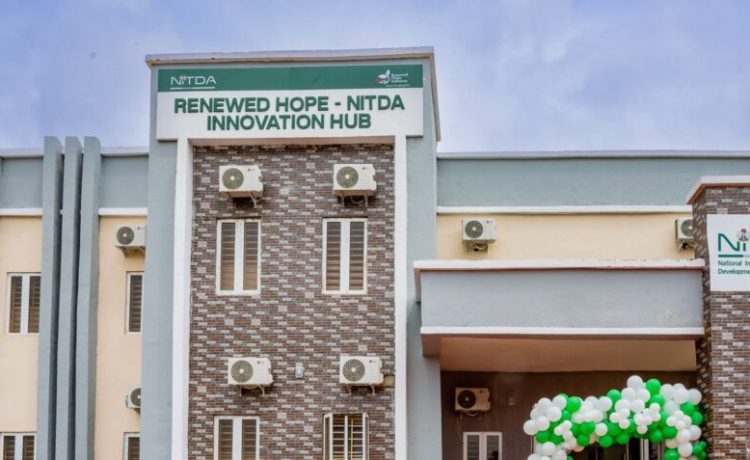
The federal government has commissioned and handed over the Renewed Hope–NITDA Innovation Hub, a state-of-the-art artificial intelligence and robotics centre located at Obafemi Awolowo University (OAU), Ile-Ife.
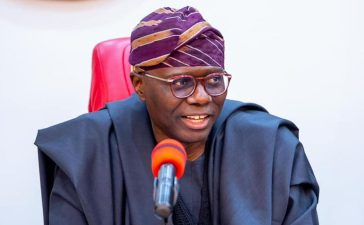
The facility was unveiled on Monday, June 8, by the Minister of Communications, Innovation and Digital Economy, Dr. Bosun Tijani, during an official ceremony at the institution.
Developed by the National Information Technology Development Agency (NITDA) in partnership with the Renewed Hope Initiative, the hub is equipped with advanced laboratories focused on artificial intelligence, robotics, additive manufacturing, and the Internet of Things (IoT).
The innovation hub is designed to bridge the gap between academic learning and real-world industry demands by providing students and researchers access to modern tools and infrastructure often unavailable in Nigerian universities.
Tijani described the project as a strategic investment in Nigeria’s youth, stressing that it goes beyond physical infrastructure to unlocking creative and technological potential.
He urged students of OAU and the wider academic community to fully utilise the facility to develop innovative solutions capable of driving a self-sustaining digital economy.
According to him, the hub is intended to serve as a launchpad for students seeking to translate theoretical knowledge into practical, industry-ready innovations.
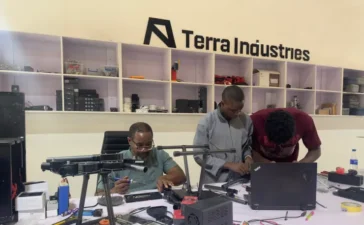
The facility includes four specialised laboratories covering artificial intelligence, robotics, additive manufacturing, and IoT technologies—fields that are increasingly central to global technological development.
Additive manufacturing, also known as 3D printing, is widely used across sectors such as healthcare, aerospace, and construction, and its inclusion reflects efforts to expose Nigerian students to industrial-scale innovation tools.
The robotics and IoT labs are expected to support hardware-based innovation, addressing a long-standing challenge for local startups that often struggle with the high cost of prototyping and equipment.
Beyond the hub’s commissioning, the minister reiterated the government’s broader digital infrastructure agenda, noting that Nigeria’s digital ecosystem is expected to fully mature by 2027.
He highlighted ongoing projects such as the deployment of 90,000 kilometres of fibre optic cables, the rollout of new communication satellites, and the installation of 3,700 rural telecom towers aimed at expanding connectivity nationwide.
According to him, these initiatives are central to improving digital access, boosting innovation, and positioning Nigeria as a competitive player in the global technology space.
The government says the combined investments in infrastructure and innovation hubs are part of its broader strategy to build a robust digital economy driven by skilled human capital and accessible technology platforms.