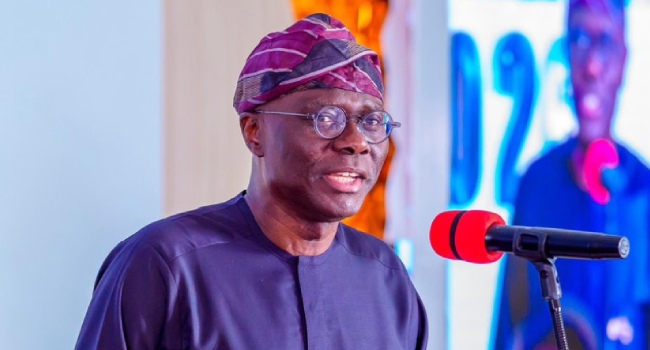
Lagos State Governor Babajide Sanwo-Olu has called on the private sector to increase investment in key areas of the state’s economy, including transportation, energy, water infrastructure, technology, agriculture and agro-processing.
He made the appeal on Monday at Invest Lagos 3.0, themed “Lagos: The Business Gateway to Africa,” where he outlined the state’s economic priorities and investment opportunities.
According to the governor, Lagos remains rich in untapped potential, particularly in infrastructure and public utilities, and requires significant private capital to unlock sustainable growth.
Sanwo-Olu highlighted the water sector as one area with major investment opportunities, despite ongoing support from existing financing arrangements.
“We have opportunity in waterways infrastructure, we are currently enjoying some credit facilities, but we still have a lot of opportunity. Just one thought of Lagos for water,” he said.
He also identified transportation as a critical driver of economic expansion, stressing that improved mobility would significantly enhance productivity and business activity across the state.
The governor noted that rail and water transport systems are central to Lagos’ long-term development strategy.
“If we solve transportation issues in Lagos, what we are doing is we are unlocking the economic potential. Travel time will be completely reduced. People can get to one point or the other easily, quicker, and faster,” he said.
Sanwo-Olu added that efficient transport systems would improve the ease of doing business and increase returns on investment for private investors.
“It keeps money in their pocket, but they are able to do and transact better. And the private sector can indeed track their investment, because the numbers are there,” he said.
The governor also emphasised the importance of expanding investment in the technology sector, particularly in digital infrastructure and data services.
He said Lagos is scaling up fibre connectivity projects and positioning itself as a hub for data centre investments and emerging technologies such as artificial intelligence.
“Today, we’re building what we call not just data centres, we’re building fibre connectivity around the city. The future is technology. So what we are expecting from that is for the private sector to bring in more data centres because the future is AI,” he said.
According to him, while progress has been made in developing the tech ecosystem, there is still significant room for expansion.
“We’ve opened one, but there’s still huge opportunities in technology, in data, and infrastructure,” he added.
Sanwo-Olu further pointed to agriculture and agro-processing as strategic sectors for investment, noting that Lagos’ large population provides a strong domestic market for agricultural production and supply chains.
“With 24, 25 million people, you know that this is a ready market,” he said.
He stressed the need to strengthen food security systems and improve logistics to ensure efficient distribution of agricultural products.
The governor reaffirmed his administration’s commitment to creating an enabling environment for investors and bridging infrastructure gaps across critical sectors of the Lagos economy.
Analysts say Lagos continues to position itself as one of Africa’s most attractive investment destinations, driven by its population size, market demand and ongoing infrastructure development initiatives.