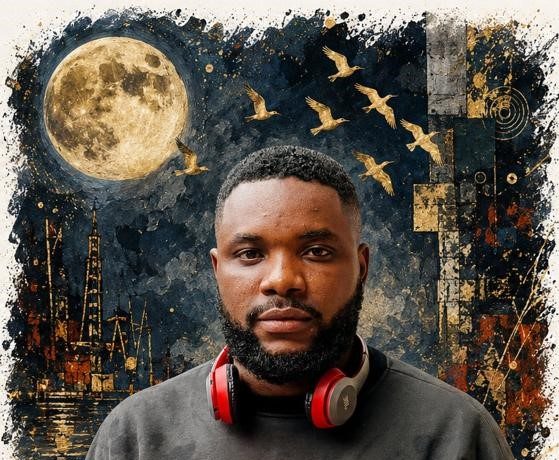
As part of the forthcoming Here & Now: Becoming, Identity, Memory, and Environment exhibition opening at Lagos’ Thought Pyramid Art Centre on June 13, contemporary artist Don Okuchukwu Eseagwu offers a compelling exploration of the human experience through symbolism, memory, and reflection.
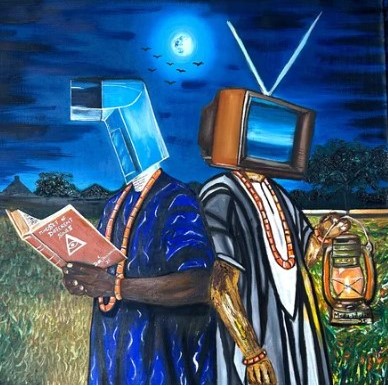
Born in Delta State and a graduate of the University of Benin, Okuchukwu has been creating art since the age of seven.
Over the years, he has developed a distinctive visual language marked by recurring motifs such as the moon and seven birds in flight—symbols that have become synonymous with his artistic identity.
Working across mixed media, his paintings navigate the delicate space between reality and imagination, inviting viewers to contemplate themes of identity, humanity, resilience, nature, and transformation.
In this exclusive conversation with AV1 News, the artist reflects on his creative journey, the inspirations behind his signature symbols, the influence of his Delta roots, and the role of art in an increasingly fast-paced and technology-driven world.
He also shares insights into the works he will be exhibiting at Here & Now and explains how his practice contributes to the evolving narrative of contemporary African art.
AV1: You began drawing at the age of seven. Looking back, what moments or influences convinced you that art would become your life’s calling?
Okuchukwu: Beginning to draw at the age of seven wasn’t just a hobby for me; it was the moment I discovered a language that made sense when words felt insufficient. At that age, the world is vast and filled with things you are trying to process. I found that the moment I picked up a pencil, I could create my own world, capture my surroundings, and make sense of my thoughts on paper.
The turning point that convinced me this was my life’s calling came when I realized the profound impact a simple drawing could have on others. It wasn’t just about rendering an object accurately, but about creating an emotional reaction, watching someone pause, lean in, and connect with a story I had drawn.
As I grew older,my relationship with art deepened from a childhood passion into a serious vehicle for documentation. I realized that art wasn’t just something I did; it was the lens through which I was meant to engage with the world, process my environment, and connect with humanity.
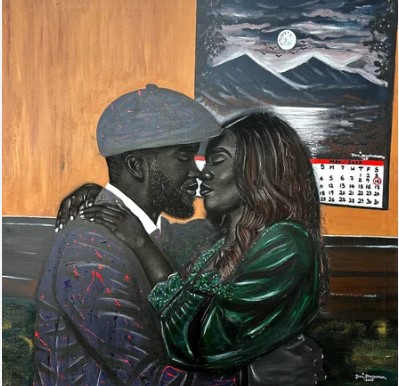
AV1: Your work explores identity, memory, humanity, and nature. How do these themes connect within your artistic practice?
Okuchukwu: For me, these four themes like identity, memory, humanity and nature are not separate concepts, but rather interconnected layers of the same story.
Humanity and identity are always shaped by memories. who we are is deeply rooted in what we remember, what we have lost and the personal narratives we carry.
However, humans do not exist in a vacuum. We are tied to nature. By weaving natural elements and symbolic motifs into my work, I create a dialogue between our internal struggles and the external world.
AV1: The moon is a recurring symbol in your work and has even become part of your artistic identity. What does the moon represent to you personally and artistically?
Okuchukwu: In my compositions, the moon acts as a visual lighthouse. It represents a constant anchor in the midst of change.
Personally, it represents a space for reflection, vulnerability and perseverance. It’s like a beacon of hope to me. a reminder that there is beauty in every phase of growth, illumination , obstacles and darkness that we go through as humans.
AV1: The seven birds that frequently appear in your compositions have become part of your visual language. What inspired this motif, and what story do they tell?
Okuchukwu: The motif of the seven birds in flight is central to my visual language, representing both personal liberation and spiritual journeying.
For me, flight symbolizes the ultimate desire of the human soul to break free from limitations, break free from grounding realities of everyday life.
The number seven is deliberate as it reminds me of the age I first held a pencil to draw as an artist. I experienced freedom from doing so. It is a number of completeness, perfection and intuition.
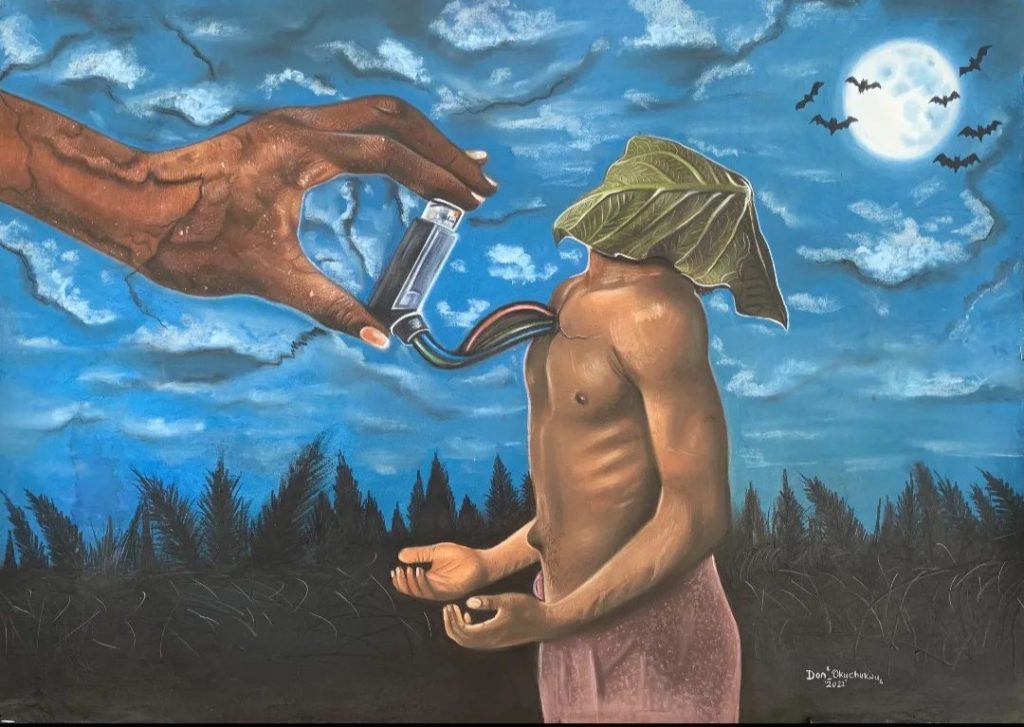
AV1: Much of your work seems to exist between reality and imagination. How do you navigate that space when creating a new piece?
Okuchukwu: For me, navigating the space between reality and imagination isn’t about escaping the real world, but rather about peeling back its surface to reveal the deeper psychological truths underneath.
When I begin a new piece, the process usually starts with a very grounded observation, an emotion, or a personal narrative.
From there, I deliberately allow symbolic elements to interrupt that reality. It’s a delicate balancing act. The goal is to create a visual threshold where the viewer feels safe enough to step in, but intrigued enough to question what is real and what is felt.
AV1: As a mixed-media artist, what attracts you to working with multiple materials rather than a single medium?
Okuchukwu: What attracts me to mixed media is the sheer freedom and layered storytelling it allows. A single medium often feels like a single voice, but a painting built with multiple materials becomes a conversation.
When you combine the raw, immediate and gritty texture of charcoal with the vibrant, fluid layers of acrylic or introduce unexpected elements into the space,you create a physical tension on the canvas that mirrors the complexity of human experiences. It also allows room for experimentation.
AV1: Your works often evoke tranquility while suggesting movement and transformation. Is this balance intentional, and what does it reflect about your view of life?
Okuchukwu: Yes, this balance is entirely intentional. In my work, tranquility isn’t about static silence or a lack of life, it is about finding a center of gravity amidst constant change.
I have always been fascinated by the idea of quiet transitions, the moments where a profound internal shift is happening but the surface remains calm and composed.
This directly reflects how I view life and our shared human journey. We are rarely ever entirely at rest nor are we in a state of chaotic, unguided chaos; we exist in a continuous state of becoming.
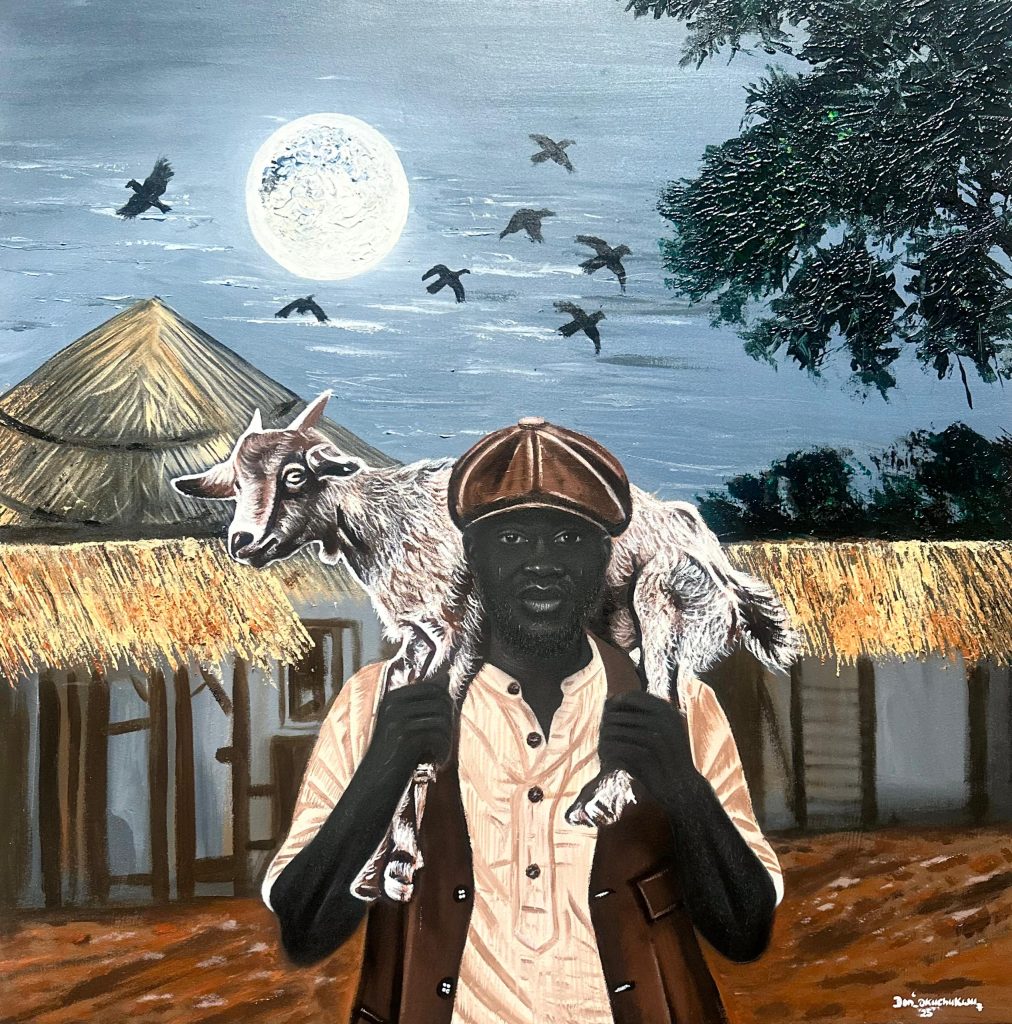
AV1: Delta State has clearly influenced your artistic perspective. In what ways has growing up there shaped your understanding of identity and community?
Okuchukwu: Growing up in Delta State fundamentally shaped the lens through which I view both the world and the canvas.
It is a place defined by an incredible richness of culture, resilience and storytelling.
The environment carries a distinct communal energy, a deep-seated understanding that identity is never formed in isolation, but is always woven into the collective history, struggles and triumphs of the people around you.
The sense of community I experienced while growing up in delta instilled in me a desire to make art that speaks to shared human truths. It taught me to look closely at the people around me and to value our histories.
AV1: The night plays a central role in your work. Why are you drawn to nighttime as both a physical setting and a metaphorical space?
Okuchukwu: Physically, the nighttime strips away the noise, distractions and frantic energy of the day. It creates a natural sanctuary of quiet and stillness where the external world recedes, leaving room for deep, uninterrupted focus.
Metaphorically, I view the night as the landscape of the subconscious. It is the space where we confront our truest thoughts, memories, dreams and vulnerabilities.
AV1: Many viewers describe your paintings as deeply reflective and emotional. What emotions or conversations do you hope people carry with them after encountering your work?
Okuchukwu: I want to evoke emotions that are deeply human such as vulnerability, hope, resilience , identity,tranquility and a sense of wonder. I view each painting as a visual threshold and my goal is for viewers to leave that space feeling a little more grounded, a little more aware of their own journey and comforted by the reminder that our quietest, most private emotional experiences are often the very things that connect us all.
AV1: The exhibition is titled “Here and Now.” How does your body of work engage with the ideas of presence, awareness, and living in the moment?
Okuchukwu: The title “Here and Now” is both a declaration and an invitation. In a world that constantly pulls our attention toward the anxieties of tomorrow or the weight of yesterday, this body of work is a deliberate attempt to anchor both myself and the viewer in the immediate present.
For instance, in a piece like “The Street Made Us,” which I will be exhibiting , the work forces an immediate awareness of our environment and the collective identity shaped by the physical spaces we occupy right now.
It highlights a gritty, undeniable presence. On the other hand, “SOS (Times Are Hard)” directly confronts the emotional and socioeconomic weight of the current moment of hardship in the country.
It doesn’t shy away from the difficult realities of the present; instead, it anchors the viewer in a shared, vulnerable awareness of the immediate struggles we face.
By pairing these intense realities with an overarching atmosphere of deep reflection, the exhibition acts as a physical sanctuary where people can step out of the rush of daily life and simply exist,fully aware, fully mindful, and completely present in the space they occupy.
AV1: In a fast-paced world dominated by technology and constant distractions, what role do you believe art plays in helping people reconnect with themselves?
Okuchukwu: In today’s world, our attention is constantly fragmented. We are flooded with digital noise, notifications and temporary trends that pull us away from our internal state. In this environment, art ceases to be a luxury; it becomes a necessity, an anchor. It serves as a visual and emotional pause button.
Unlike a digital screen designed to keep you scrolling, a physical painting asks you to stand still. It provides a quiet, safe sanctuary where viewers can confront their own vulnerability, memories and emotions without distraction.
Ultimately, art gives people permission to disconnect from the external rush so they can reconnect with their own breathing, their own thoughts and their own humanity.
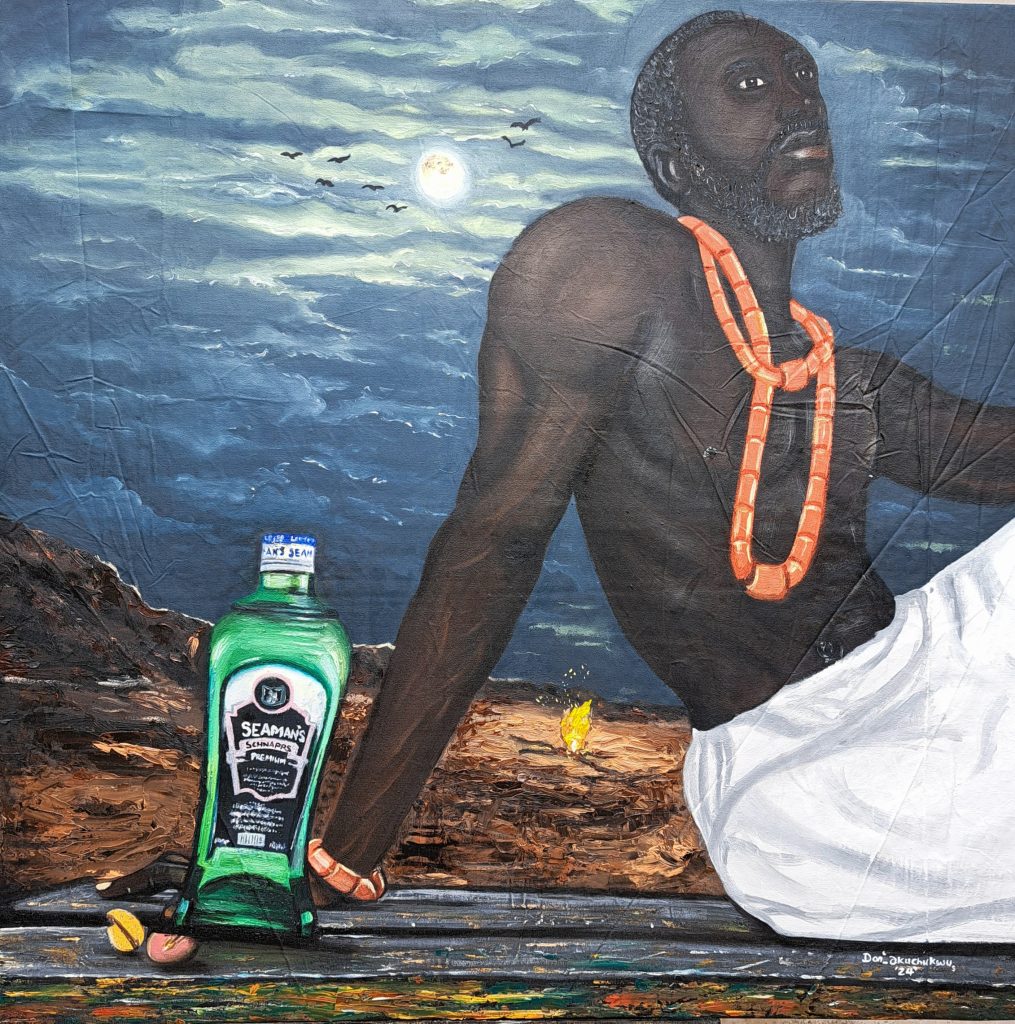
AV1: Contemporary African art is receiving increasing global attention. How do you see your work contributing to the broader narrative of African contemporary art?
Okuchukwu: What my work brings to this broader conversation is an exploration of the internal, psychological and universal human experience through a distinctly African lens.
While my art is deeply rooted in my environment, the cultural richness of Delta State, and the realities of contemporary Nigeria, it speaks a global language of surrealism and deep reflection. I am showing that African narratives are not monolithic.
We aren’t just documenting external struggles; we are exploring deep emotional landscapes, vulnerability and spiritual transitions.
My contribution is about expanding that narrative to show that contemporary African art can be deeply philosophical, poetic and intimately reflective, proving that our localized experiences carry profound universal truths.
AV1: What has been the most significant lesson you’ve learned about yourself through your artistic journey so far?
Okuchukwu: The most significant lesson I learned is that creativity requires absolute vulnerability and that true strength lies in embracing the quiet & uncertain spaces of growth.
Before I could build a physical sanctuary for others to experience art, I had to learn how to sit with my own thoughts, my own vulnerabilities and the raw realities of my environment. Art has taught me that transformation is never a loud overnight event.it is a continuous, patient process of layering and refinement.
I have also learned to trust my intuition. My journey has shown me that I am far more resilient than I realized and that my voice is at its most powerful when I stop trying to conform to external expectations and instead speak directly from a place of authentic, deeply rooted reasoning.
AV1: Looking ahead, what new themes, materials, or artistic directions are you excited to explore, and what can audiences expect from Moonlight Art in the future?
Okuchukwu: Looking ahead, audiences can expect Moonlight Art to push the boundaries of storytelling even further, both in terms of emotional depth and physical execution.
I want to create works that are increasingly dimensional pieces where the textures themselves tell a story before the viewer even decodes the imagery.
Ultimately, the future of Moonlight Art is about building on the foundation of spaces like the Here and Now exhibition.
Audiences can expect a continuous commitment to authenticity, a fearless exploration of human vulnerability and an ever-evolving visual language that invites people to slow down, look inward and connect with their truest selves.