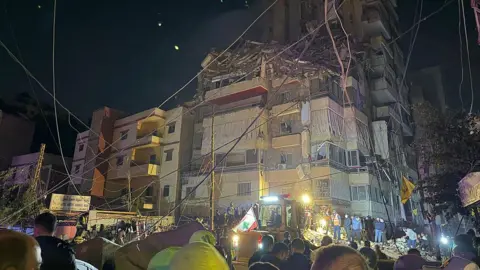
Israel launched an airstrike on Beirut on Wednesday for the first time since agreeing to a ceasefire with Hezbollah last month, escalating tensions amid ongoing diplomatic efforts involving the United States and Iran.
The strike targeted Beirut’s southern suburbs, an area known as a stronghold of Hezbollah.
In a joint statement, Benjamin Netanyahu and Israel Katz said the operation targeted a commander of Hezbollah’s elite Radwan force.
Israeli media reported that the commander was killed in the strike, although there was no immediate confirmation from either the Israeli military or Hezbollah.
The ceasefire in Lebanon has been viewed as a key component of the broader truce discussions between the United States and Iran, with Tehran demanding an end to Israeli attacks in Lebanon as part of any wider regional agreement.
The latest strike now threatens the fragile ceasefire that had largely halted Israeli attacks on Beirut.
Despite the truce, Israeli troops have remained stationed in areas south of the Litani River, while Israeli strikes have continued in southern Lebanon.
Hezbollah has responded by launching rockets and armed drones toward Israeli soldiers.
Earlier on Wednesday, Israel issued evacuation warnings for residents in several villages north of the Litani River, raising concerns that the military could be expanding its operational zone.
Diplomatic talks between Israel and Lebanon have continued but remain limited mainly to ambassadorial contacts.
Nawaf Salam said it was still too early to discuss any high-level meeting between Lebanese and Israeli leaders.
According to Lebanon’s National News Agency, Salam said strengthening the ceasefire would be necessary before broader negotiations could move forward.
The United States last month hosted meetings between Israeli and Lebanese ambassadors in Washington, although Hezbollah strongly opposes such diplomatic engagement.
Since Hezbollah opened fire in support of Iran on March 2, Lebanon’s leadership under Salam and President Joseph Aoun has initiated some of Beirut’s highest-level contacts with Israel in decades.
The diplomatic outreach reflects growing divisions within Lebanon between Hezbollah and its political opponents.
Last month, Donald Trump announced a three-week extension of the ceasefire and said he hoped to host Netanyahu and Aoun for talks aimed at reaching a peace agreement this year.
Salam stressed that Lebanon is seeking peace rather than full normalisation with Israel.
“Our minimum demand is a timetable for Israel’s withdrawal,” he said, while also confirming that the Lebanese government is developing plans to place all weapons under state control, an effort widely viewed as targeting Hezbollah’s armed wing.
President Aoun also stated this week that conditions were not yet suitable for a direct meeting with Netanyahu.
Meanwhile, violence continued across southern Lebanon.
Lebanon’s Health Ministry said an Israeli airstrike in the town of Zelaya killed four people, including two women and an elderly man.
The Israeli military said Hezbollah had launched explosive drones and rockets toward Israeli forces in southern Lebanon, injuring two Israeli soldiers.
Israel also announced strikes on Hezbollah infrastructure in several parts of Lebanon and said its air force intercepted a hostile aircraft before it crossed into Israeli territory.
According to Lebanon’s Health Ministry, more than 2,700 people have been killed in Lebanon since the conflict intensified on March 2.
Israel says Hezbollah has launched hundreds of rockets and drones toward its territory during the same period, while 17 Israeli soldiers and two civilians have reportedly been killed.