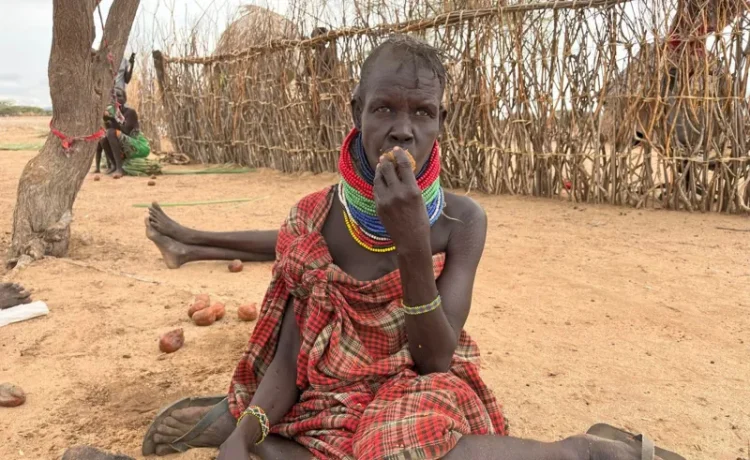
In north-western Kenya, prolonged drought has decimated livestock herds and left communities facing severe hunger. Lotkoy Ebey, a resident of Turkana, has seen her herd of 50 goats shrink to just five, highlighting the catastrophic impact of the parched landscape on both livelihoods and culture.
Although recent rains have fallen in parts of the country, officials warn that relief will not come immediately to Turkana, where rainfall has been uneven and insufficient to offset the damage caused by two consecutive failed rainy seasons. Dry riverbeds, bare grazing fields, and scarce food mark the county, where livestock are not merely economic assets but central to daily life and identity.
The drought has affected a broader swath of East Africa, leaving an estimated 26 million people facing extreme hunger across Kenya, Ethiopia, and Somalia, according to Oxfam.
Families like Ebey’s struggle to eat even once a day, often surviving on wild foods such as mikwamo, a gingerbread-like fruit harvested from doum palm trees. Gathering these fruits requires long treks into the scrubland, and excessive consumption can lead to stomach upset and drowsiness. With most goats dead and few income sources, households have little ability to purchase staple foods.
Across villages like Kakwanyang and Latimani, residents report going days without proper meals. Women and children share the few wild fruits available with the remaining livestock, while men often migrate temporarily in search of pasture.
Authorities acknowledge the severity of the crisis. Jacob Letosiro from Turkana county’s drought management team reports that over 320,000 people urgently need food assistance. He cautions that recent off-season rains are unlikely to provide immediate relief for livestock or water availability.
Humanitarian organisations, including Kenya Red Cross, World Vision Kenya, and the World Food Programme, are providing food aid to the most vulnerable households. However, the demand far exceeds available resources, leaving thousands dependent on limited distributions.
The Kenyan government has announced plans to deliver food and livestock feed to drought-affected counties, but officials warn that the scale of the crisis remains immense. For residents like Ebey, survival depends on what little resources remain and what can be foraged from the harsh environment.