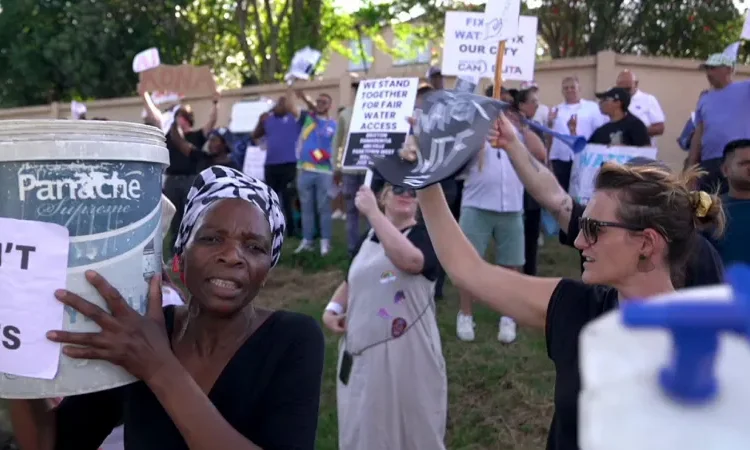
In the Johannesburg suburb of Greenside, residents of all ages gathered to protest ongoing water shortages, waving placards and banging empty plastic bottles. “We want water, we want water!” they chanted, expressing frustration after some households have gone without running water for over a month.
Northern Johannesburg is known for its leafy, affluent suburbs, but residents say the shortages are now a serious public health concern. Colin Regesky explained: “Our pipes have been bone-dry with no water coming through at all. It’s not very healthy because everyone can get sick with no running water. And also according to the constitution, it’s our right to have water.” Jenny Gillies, who has lived in the area for 40 years, called the situation “an actual disgrace” and said residents feel forced to beg and protest for access to water.
South Africa has faced chronic infrastructure challenges, with electricity shortages managed through “load shedding” from 2022 to early 2024. Over the past year, water shortages have emerged as a growing concern due to their essential role in health and hygiene.
Hammanskraal, over 100km north of Johannesburg, has experienced persistent water scarcity for more than a decade. Pastor Tshepo Mahlaule described the situation: “This is what is happening in Hammanskraal, there’s no water. People are striving for water. For two months there’s no water. Our kids need to wash every day, their uniforms need to be washed and we have no water.”
Municipalities have resorted to paying for water tankers to provide drinking water, but some residents report that drivers sell water that should be free. Dr Ferrial Adam, executive director of Watercan, explained that “water mafias” exploit municipal contracts, damaging infrastructure to maintain control and charging residents illegally. Eric Sebotsane, a local resident, confirmed that truck drivers demand payment: “Some of the trucks that deliver water in my neighbourhood charge people for water which should be free of charge.”
President Cyril Ramaphosa has urged authorities to crack down on criminal gangs controlling water tankers. Adam noted that such “water mafias” first emerged in KwaZulu-Natal and Eastern Cape, fueled by a lack of infrastructure and climate-related damage.
Political solutions, such as municipalities operating their own tankers, have been suggested but are seen as temporary. Cilliers Brink, former mayor of Tshwane, said: “The longer-term solution must be to fix infrastructure.” Adam agrees, emphasizing that reliance on tankers should remain a short-term measure, not the norm.
For residents, the water shortage impacts daily life. In Hammanskraal, workers transporting heavy water containers walk long distances to refill, highlighting the burden on the poorest communities. Despite government pledges to coordinate a response through a National Water Crisis Committee, residents say relief is urgently needed.
President Ramaphosa has stressed that municipal managers failing to uphold water responsibilities will face criminal charges. However, for communities facing months of water deprivation, a resolution cannot come soon enough.