Interest in civil nuclear energy is surging worldwide as governments seek stable, low-carbon power sources. The World Nuclear Association reported that 38 countries endorsed a COP28 declaration calling for a tripling of global nuclear capacity by 2050.
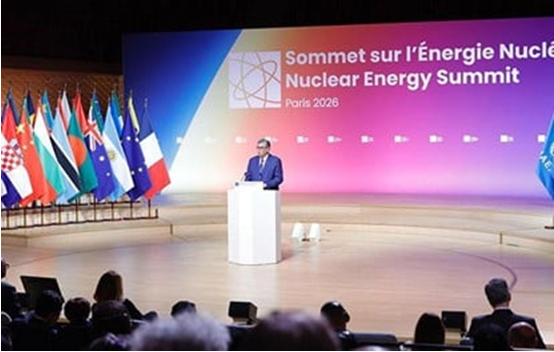
At the second World Nuclear Energy Summit held in Paris on March 10, representatives from Egypt and Morocco shared their plans to develop or explore nuclear energy as part of their national strategies. The summit was organized by France in collaboration with the International Atomic Energy Agency (IAEA) and included leaders and delegates from over 60 countries.
Civil nuclear power currently accounts for about 10% of global electricity generation, according to the WNA.
Egypt highlighted the progress of its civil nuclear program centered on the El-Dabaa Nuclear Power Plant, which will have a total capacity of 4,800 megawatts. Dr. Mahmoud Esmat confirmed that the reactor vessel for the first unit has been installed and that safety systems for the third and fourth units are also in place. Egypt has obtained authorization to build a spent nuclear fuel storage facility, and construction continues on all four reactors at the El-Dabaa site.
Esmat emphasized nuclear energy as a key pillar of Egypt’s national strategy, enhancing electricity system stability and supporting regional interconnection projects, including a planned link with Saudi Arabia and a feasibility study for a potential connection to Europe through Greece. He also highlighted Egypt’s role in training African nuclear technicians through partnerships with the IAEA and the African Regional Cooperative Agreement for Research, Development and Training in Nuclear Science and Technology (AFRA).
In Morocco, Prime Minister Aziz Akhannouch said the gradual integration of civil nuclear energy complements the country’s 2009 energy strategy, which prioritizes diversification, renewable energy expansion, and energy security. By 2025, renewable energies are projected to account for over 46% of Morocco’s electricity capacity, rising to 52% before 2030.
Akhannouch noted that nuclear power could enable green hydrogen production, seawater desalination, and nuclear medicine development. He also cited Morocco’s phosphate deposits, which contain significant natural uranium resources, as strategically valuable for international nuclear discussions.
Across sub-Saharan Africa, nuclear interest is growing. South Africa remains the continent’s only nuclear power operator, while countries such as Ghana, Burkina Faso, and Rwanda explore small modular reactors (SMRs), a new generation of compact nuclear installations designed to reduce cost and deployment time.