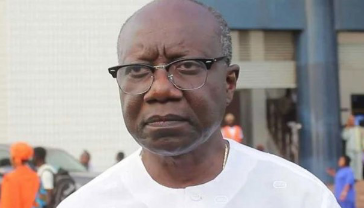
Renowned historian, Toyin Falola, has said hostile political rhetoric in the United States has quietly but significantly reduced immigration flows from Africa, including tourism, education-driven mobility and diversity-based migration.
Falola spoke at the February edition of Diaspora Dialogues, held virtually via Zoom and themed “Being African in Trump’s America in the Age of ICE Raids,” on Saturday.
The session was anchored by Dr Osmund Agbo, Professor Farooq Kperogi and Professor Moses Ochonu.
According to Falola, the decline in migration is not merely the result of deportation statistics. He argued that it stems from a sustained atmosphere of fear created by the fusion of aggressive rhetoric and enforcement.
“Even immigration on its own has reduced,” he said. “People are no longer coming.”
He explained that while deportations occurred at higher levels under previous administrations, they did not carry the same public hostility that now defines the American political climate.
“At the time Obama was in power, more people were deported,” Falola noted, referring to former US President Barack Obama, “but they did it quietly.”
In contrast, he argued that the Trump-era approach merged policy with performative hostility. This, he said, discourages migrants long before they reach an airport or embassy.
“Some of this data and records are being exaggerated by the Trump administration,” he said. “They have fused rhetoric with deportation policies. People have noticed that even immigration to the US on its own has reduced.”
Falola stressed that the impact extends beyond undocumented migration to affect tourism, education and legal entry routes.
“Who would have a good reason to come for tourism in the US today?” he asked. “People are no longer coming.”
He warned against treating global crises as isolated events. According to him, Africans often underestimate how distant conflicts shape migration, food security and political behaviour.
“We tend to fragment reality,” he said. “If Russia attacks Ukraine and you are living in Tanzania, you would assume it is none of your business. You have forgotten that Ukraine produces 40 per cent of the world’s grain that you consume.”
He added that geopolitical shocks travel across regions through historical and economic corridors.
“You must realise that one way or another, what happens in Ukraine will affect you. If people think this will not affect them, then they do not understand how geopolitics works,” he said.
Falola revealed that Africa’s presence in global spaces often becomes visible only during crises.
“It was when the war broke out that I learnt that there were 10,000 Nigerians in Ukraine,” he said. “I never knew that.”
Drawing parallels between the Ukraine war, Middle East tensions and Africa’s vulnerability, he warned that instability spreads through interconnected regions.
“The area called Borno State, which has Boko Haram, is linked to Darfur,” he said. “This US–Israeli/Iran crisis will get to Sudan because of links to the Horn of Africa.”
Returning to the theme of life as an African in the US, Falola said the conversation could not be handled delicately in the face of what he described as open racial hostility.
“I don’t think we can discuss this topic gently,” he said.
He criticised remarks he attributed to the White House describing former President Obama and his wife in racially derogatory terms, saying such language would be unacceptable in any professional setting.
“You may not like Barack Obama. Pan-Africanists do not like him because of Gaddafi. But describing one of Africa’s as an ape is unacceptable,” he said.
Falola argued that African communities in the US are disproportionately affected by immigration crackdowns, even when public discourse focuses largely on Latin America.
“If you read American newspapers, you would think the focus is on those from Latin America,” he said. “But if you collect data, you will find African communities — Algeria, Ethiopia, Ghana, Cameroon, Senegal — experiencing visa scrutiny, asylum standards and deportation proceedings.”
He also questioned the credibility of some asylum claims, suggesting that exaggerated narratives have contributed to hostile policy responses.
Even so, he maintained that fear, not legality alone, now shapes migration decisions.
“It is believed that even if Trump tunes down the rhetoric, the number is on its own reducing,” he said. “People are no longer coming.”
Posing a series of questions, Falola asked what daily life now looks like for Africans under such conditions.
“What do you do as an African living in Nashville under this kind of condition?” he asked. “What do you do if you are a Muslim in Atlanta? As a religious person making your small income and attending your mosque, what do you do in Philadelphia?”