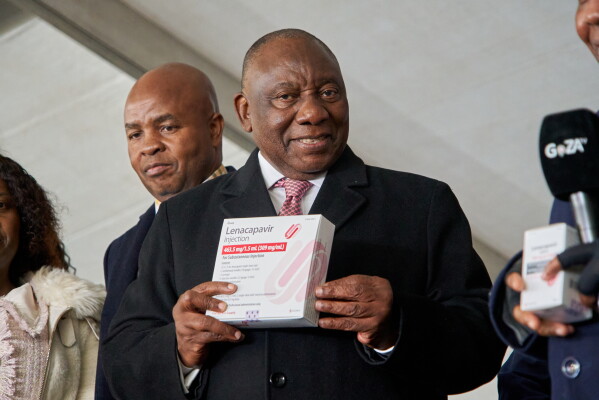
South Africa has officially launched the rollout of lenacapavir, a groundbreaking HIV prevention drug that requires only two injections per year.
The launch marks a significant milestone in the country’s battle against HIV, coming about 18 months after US aid cuts affected several HIV-related programmes.
Speaking at the launch event held at Lilian Ngoyi Stadium in Secunda, Mpumalanga province, President Cyril Ramaphosa described the introduction of the drug as a major turning point in the fight against the virus.
“Now we have definitely moved away from denialism to treatment and now to elimination,” Ramaphosa told the crowd.
South Africa has the highest HIV burden in the world, with more than 8 million people living with the virus. Health authorities hope the new prevention method will help reduce the country’s annual HIV infection rate, which currently ranges between 140,000 and 170,000 new cases.
The first shipment includes 37,920 doses, which are being distributed across 360 health facilities in six provinces with high HIV prevalence.
However, some civil society organisations argue that the initial rollout is too limited to make a meaningful impact on infection rates.
Advocacy groups have called for at least 2 million doses to be made available if South Africa hopes to significantly reduce the number of new HIV infections each year.
The government has already secured 912,000 doses of lenacapavir through a $29 million grant from the Global Fund. The supply is expected to provide protection for approximately 456,000 people.
Health experts believe the injectable treatment could transform HIV prevention efforts by addressing one of the biggest challenges associated with oral prevention medications—pill fatigue and missed doses.
For many young South Africans, the new drug offers renewed hope.
Nineteen-year-old Olwam Plaatjie, who participated in clinical trials for lenacapavir, said her decision to use preventive HIV medication was influenced by personal experiences growing up.
Having witnessed the devastating impact of HIV on family members and within her community, she decided to take proactive steps to protect herself.
“I’ve seen people default on their medication and get very sick,” she said.
“That made me realise that one day it could be me, so I decided to prevent that and protect myself because people don’t disclose their status. So that’s why I made the decision to take preventative measures.”
South Africa plans to prioritize groups considered to be at higher risk of HIV infection during the initial rollout phase.
These groups include people who inject drugs, sex workers, transgender individuals, adolescent girls and young women aged 15 to 24, as well as pregnant and breastfeeding women.
Health officials believe targeting vulnerable populations first will help maximize the impact of the programme while expanding access over time.
The introduction of lenacapavir is being viewed as one of the most significant advances in HIV prevention in recent years and could play a key role in South Africa’s long-term goal of ending new HIV infections.