The Vice President of Nigeria, Kashim Shettima, has called for a deliberate and forward-looking framework for youth leadership development, warning that Nigeria’s status as one of the world’s youngest nations would amount to little without corresponding institutional investment.
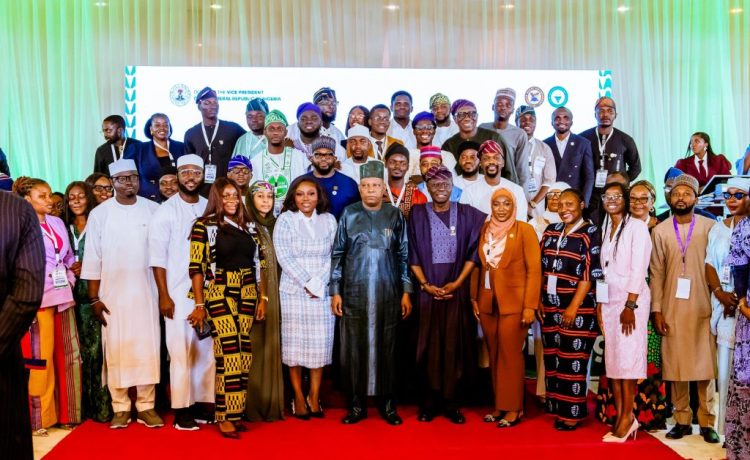
Speaking on Monday in Abuja at the Abuja Dialogue 2026, convened by the Office of the Vice President in collaboration with the Lateef Jakande Leadership Academy, Shettima said Nigeria’s demographic strength must be treated as a strategic national asset rather than a rhetorical talking point.
“We are one of the youngest nations on earth. That fact should not be treated as a line for conferences or a statistic for brochures. It is a national condition with profound consequences,” he said.
The Vice President stressed that Nigeria’s future would depend not only on natural resources or policy ambitions, but on structured systems designed to sustain leadership continuity and national development.
He noted that youth leadership must move beyond symbolism and be embedded in institutional processes that prepare young people for responsibility, accountability, and governance.
“Youth leadership must be understood with clarity. It is not a ceremonial handover waiting for age to perform its arithmetic. It is a structured process through which young men and women are prepared, trusted, integrated, and supported within the institutions that shape our future,” he said.
Shettima added that leadership in the modern era must be cultivated through deliberate pathways across education, governance, enterprise, and civic institutions, stressing that responsibility and decision-making opportunities are essential for building competence.
“Leadership grows when young people are given room to learn, to contribute, to make decisions, and to be held accountable for results,” he added.
He also commended the organisers of the Abuja Dialogue 2026, describing it as a timely platform for rethinking governance in response to global shifts in technology, economics, and public expectations.
Lagos State Governor, Babajide Sanwo-Olu, who also spoke at the event, praised the initiative and highlighted ongoing youth development programmes in Lagos, including the IBILE Youth Academy and the Lagos State Employment Trust Fund.
He described the Lateef Jakande Leadership Academy as a talent incubator offering young Nigerians hands-on public sector experience, mentorship, and leadership training aimed at addressing real societal challenges.
Also speaking, the Deputy Chief of Staff to the President, Ibrahim Hassan Hadejia, said youth development must be treated as a structural element of governance rather than a symbolic gesture.
Minister of Youth Development, Ayodele Olawande, reaffirmed the federal government’s commitment to creating platforms that enable young Nigerians to participate actively in national development.
Executive Secretary of the Lateef Jakande Leadership Academy, Ayisat Agbaje-Okunade, described the Abuja Dialogue 2026 as a critical step toward repositioning youth leadership as a central pillar of governance and economic growth.
She added that the dialogue seeks to transform policy discussions into actionable programmes that strengthen institutional resilience and national development.