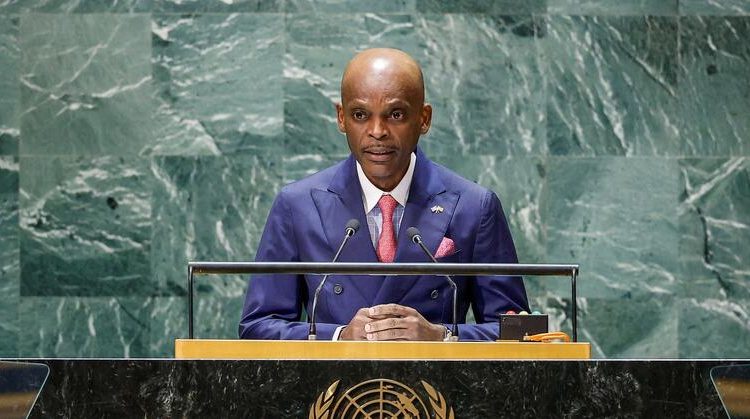
Togo is preparing to ask United Nations member states to adopt a new world map that more accurately reflects the true size of Africa, according to the country’s foreign minister.
The proposal seeks to replace the centuries-old Mercator projection, a widely used map design that critics say distorts the relative size of continents and underrepresents Africa.
Togo’s Foreign Minister, Robert Dussey, said the move is part of a broader effort led by the African Union to correct geographical misrepresentations that have shaped global perceptions for centuries.
“The size we see of the African continent on the globe is geographically inaccurate,” Dussey said in an interview with Reuters on Monday. He added that the campaign seeks to promote “scientific truth” in how the world is mapped.
The African Union has tasked Togo with promoting the “Correct The Map” campaign, which calls for governments and international organisations to abandon the Mercator projection.
The initiative is backed by advocacy groups Africa No Filter and Speak Up Africa.
The campaign encourages adoption of the Equal Earth projection, a modern mapping system designed to better represent the true size of countries and continents.
The widely used Mercator projection was developed in the 16th century by cartographer Gerardus Mercator for navigation purposes.
While effective for sea navigation, the projection significantly distorts land masses. Areas closer to the poles, such as Greenland and parts of North America, appear much larger than they actually are, while regions near the equator — including Africa and South America — appear smaller.
For example, Greenland appears roughly the same size as Africa on many Mercator maps, even though Africa is about 14 times larger in reality.
Supporters of the campaign say the distortion has long influenced how Africa is perceived globally, affecting narratives in education, media and policymaking.
Moky Makura, executive director of Africa No Filter, said accurate cartography goes beyond geography.
“Accurate representation is not just about maps — it is about agency, progress, and ensuring the world sees Africa as it truly is,” she said.
Earlier this year, the African Union adopted a resolution encouraging its 55 member states to move away from the Mercator projection and promote the Equal Earth map instead.
According to Dussey, Togo is now preparing a draft resolution that will be presented to the United Nations General Assembly. A vote could take place during the next UN General Assembly session in September.
If adopted, the resolution would formally endorse the Equal Earth projection as a more accurate global map standard.
Dussey said the outcome of the vote would reveal how countries respond to calls for a fairer representation of the world’s geography.
“It goes without saying that African countries are already receptive to this initiative,” he said.
The push comes shortly after the United Nations passed an Africa-led resolution recognising slavery as the “gravest crime against humanity” and calling for reparations — a vote that exposed divisions among member states over historical accountability.
Advocates say the campaign to correct global maps is another step toward reshaping how Africa is represented in global systems and narratives.