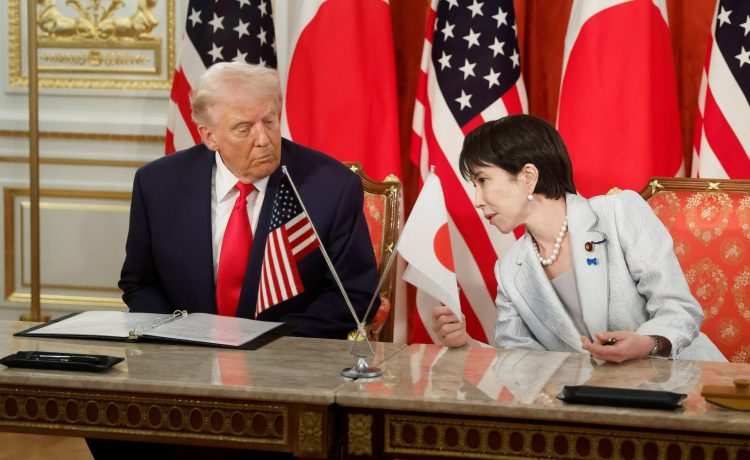
Donald Trump may use a White House meeting on Thursday with Sanae Takaichi to press for Japanese support in the ongoing war on Iran, potentially putting Tokyo in an awkward position as it evaluates how much assistance it can provide.
While Trump has publicly criticised allies for lukewarm support for the U.S.-Israeli military campaign, he is reportedly seeking more ships to clear mines and escort tankers through the Strait of Hormuz, which has been largely closed by Iran during the conflict.
The visit, originally planned to strengthen decades-old security and economic ties, comes at a sensitive time. Takaichi has sought to shift Japan away from its post-World War Two pacifist constitution, but the Iran war remains unpopular domestically, limiting her options to offer military assistance.
“This has suddenly become a very fraught visit for Takaichi,” said Chris Johnstone, a former White House official and current partner at the Asia Group consultancy. “She was hoping to be effectively the last voice in the room that could influence the president’s approach to his trip to China. Instead, she’s going to be basically the first ally in the room responding to Trump’s request for assistance in the Middle East.”
Takaichi, Japan’s first female prime minister, has previously emphasised the threat posed by a regionally assertive China, particularly regarding Taiwan. During the meeting, she may seek to remind Trump of these priorities while managing U.S. requests for support in Iran.
According to Japanese sources, Trump may also request that Tokyo produce or co-develop missiles to replace U.S. munitions depleted by the Iran war and the conflict in Ukraine. Japan is reportedly considering how to respond, balancing constitutional limits and domestic political considerations.
Japan has maintained diplomatic relations with Iran, creating potential channels for diplomacy, although past mediation efforts with Tehran, such as in 2019, were unsuccessful. Takaichi is also expected to reaffirm Japan’s participation in the “Golden Dome” missile defense initiative, designed to detect and counter threats from orbit.
In addition to security discussions, the leaders are expected to address trade, energy, secure supply chains, and bilateral cooperation in science, technology, and defense. Japan is also anticipated to announce a new wave of investment in U.S. projects, potentially pledging around $60 billion as part of a second tranche following an initial $36 billion commitment in critical minerals and energy.