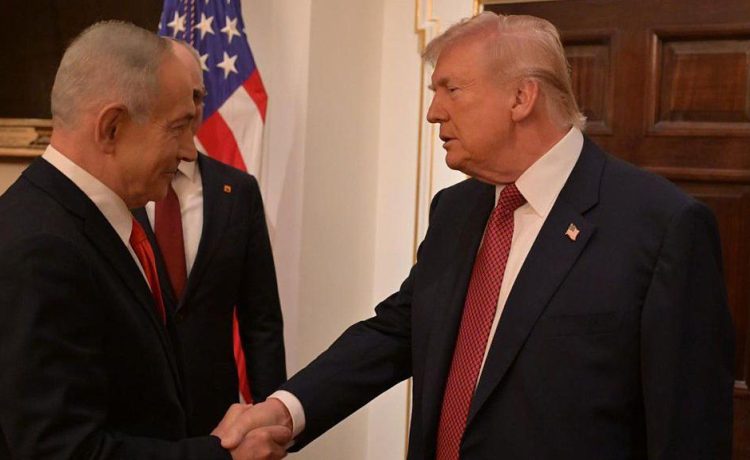
US President Donald Trump has said he insisted that negotiations with Iran continue during a White House meeting with Israeli Prime Minister Benjamin Netanyahu, while warning that Washington may take action if a nuclear deal is not reached.
The two leaders met for nearly three hours amid rising tensions across the Middle East and intensifying negotiations over Iran’s nuclear programme.
In a post on Truth Social after the meeting, Trump described the talks as “very good” but said no definitive agreement had been reached.
“There was nothing definitive reached other than I insisted that negotiations with Iran continue to see whether or not a deal can be consummated,” he wrote.
Trump added that reaching a deal remained his “preference,” but warned: “If one cannot be reached, we will just have to see what the outcome will be.”
Netanyahu’s office said the leaders discussed “the security needs of the State of Israel in the context of the negotiations” and agreed to continue their “close coordination and relationship.”
The Israeli prime minister is widely expected to push for a tougher agreement that would not only halt Iran’s uranium enrichment but also curb its ballistic missile programme and end support for proxy groups such as Hamas and Hezbollah.
Ahead of the meeting, Netanyahu’s office said he believes any negotiations must include limiting ballistic missiles and dismantling what it described as the “Iranian axis.”
Iran, however, has signalled it is willing to limit its nuclear activities in exchange for sanctions relief but has rejected broader demands.
Iranian President Masoud Pezeshkian warned before the talks that Tehran would “not yield to their excessive demands.” Speaking at a rally in Tehran marking the 47th anniversary of the Islamic Revolution, he said Iran was “not seeking to acquire nuclear weapons” and was ready for verification.
“Our Iran will not yield in the face of aggression,” Pezeshkian said, adding that dialogue with neighbouring countries would continue to promote regional stability.
Netanyahu’s visit marks his sixth trip to the US since Trump returned to office, more than any other world leader. The meeting was notably low-key, with Netanyahu entering the White House through a side entrance and no joint press conference held afterward.
The diplomatic efforts come as the US increases its military presence in the Middle East. Trump said he was considering deploying a second aircraft carrier strike group to the region.
“We have an armada that is heading there and another one might be going,” Trump said in an interview, adding that Iran “wants to make a deal very badly.”
The USS Abraham Lincoln carrier strike group was sent to the region last month after Trump threatened strikes on Iran over its crackdown on mass protests.
Analysts say Israel fears that in a bid to secure a deal quickly, Washington could accept terms that do not fully address Tehran’s missile programme or regional influence.
“Israel is concerned that in the haste to get a deal with Iran, the president might embrace a deal that doesn’t address Iran’s missile programme or support for proxy groups,” said Daniel Byman, a professor at Georgetown University.
Meanwhile, the Trump administration is also pressing Israel and Hamas to move forward with the next phase of their ceasefire agreement in Gaza.
Israel and Hamas agreed to a ceasefire last October after a two-year war that began with the 7 October 2023 Hamas attack on Israel, in which about 1,200 people were killed and 251 taken hostage. Israel’s military campaign in Gaza has killed more than 71,000 people, according to the Hamas-run health ministry.
Both sides have accused each other of violating the ceasefire, and progress toward a second phase — which includes the disarmament of Hamas and a full Israeli military withdrawal from Gaza — has been slow.
Trump withdrew the US from the 2015 Iran nuclear deal during his first term and reinstated sanctions that severely impacted Iran’s economy. Talks resumed last year in an effort to negotiate a new agreement.
Despite the heightened rhetoric, some former US officials believe Trump may seek to avoid a direct military confrontation.
“I don’t think Trump wants a major military confrontation with Iran going into an election year,” said James Jeffrey, a former US ambassador.
For now, diplomatic channels remain open — but with both sides hardening their positions, the path to a new nuclear agreement remains uncertain.