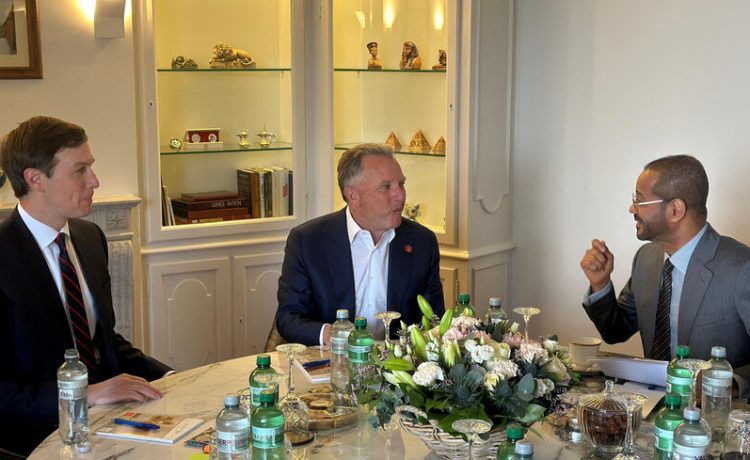
Even for a U.S. president long focused on deal-making, Donald Trump’s decision to have his top envoys handle two major international crises in a single day has raised concerns among foreign policy experts. On Tuesday in Geneva, Trump’s special envoy Steve Witkoff and son-in-law Jared Kushner attended back-to-back negotiations on Iran’s nuclear program and Russia’s war in Ukraine.
The tight schedule and dual focus sparked skepticism about whether the envoys are overstretched and able to achieve meaningful progress in either case. Brett Bruen, a former Obama administration adviser, said, “Tackling both issues at the same time in the same place doesn’t make a lot of sense,” noting Trump’s apparent emphasis on quantity over the detailed work of diplomacy.
The day began with 3½ hours of indirect talks between the U.S. team and Iranian Foreign Minister Abbas Araqchi, mediated by Oman, at high-security venues across Geneva. While both sides reported some progress, no breakthrough or immediate agreement on Iran’s nuclear program was announced.
Immediately after the Iran discussions, the envoys moved to the InterContinental Hotel in Geneva for the first of two days of negotiations on the Russia-Ukraine conflict, Europe’s largest war since 1945. Expectations for a major breakthrough were low, given the complexity of the conflict and Trump’s past campaign promises to end it quickly.
Observers noted that as long as diplomacy continues, the U.S. maintains a significant military posture near Iran, leaving regional tensions high and the potential for escalation. Critics argue that the rapid, high-profile scheduling of these talks may be more about political messaging than substantive conflict resolution.