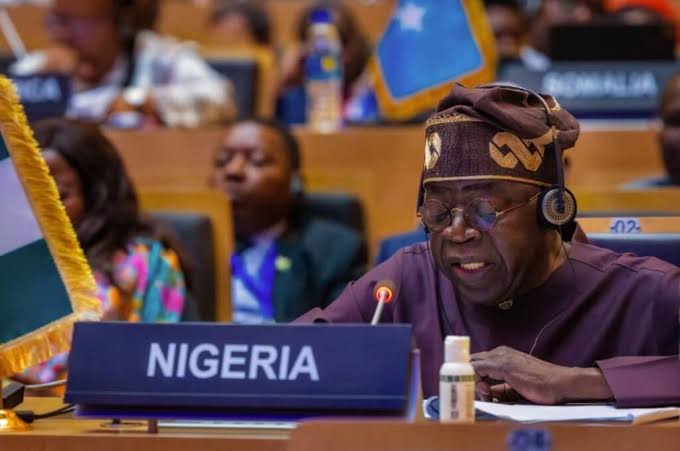
President Bola Tinubu has called for a fairer global financial system, arguing that African countries face disproportionately high borrowing costs because of persistent misjudgements by dominant international credit rating agencies.
In an opinion article, Tinubu said Africa was “paying too much to borrow”, stressing that calls to end the so-called “Africa premium” could no longer be ignored. He described the Africa premium as the gap between how the continent is assessed and the underlying reality of its economies.
The President pointed to the outsized influence of the world’s three major credit rating agencies — Fitch Ratings, Moody’s and S&P Global Ratings — saying their assessments shape investor behaviour and Africa’s access to international capital.
“Fitch, Moody’s and S&P Global Ratings… wield outsized influence over Africa’s access to international capital. Their judgements shape investor behaviour, yet they consistently misjudge African risk,” Tinubu wrote.
He cited a 2023 report by the United Nations Development Programme, which found that “idiosyncrasies” in credit ratings cost Africa about $75bn annually through excess interest payments and lost lending opportunities.
Tinubu noted that only three African countries currently hold investment-grade ratings, despite projections by the International Monetary Fund that the continent would be the world’s fastest-growing region this year.
According to him, plans to establish an African credit rating agency are a “necessary corrective”, particularly given what he described as the biggest weakness of existing global agencies — limited on-the-ground presence.
He argued that global rating models combine quantitative data with subjective judgements on political risk, institutional strength and policy durability, often relying on what he described as opaque “analyst discretion.”
“Conclusions drawn from afar fail to capture local realities,” he wrote.
Tinubu also said reliance on these assessments can amplify global market cycles. Commodity-dependent African economies, he noted, are frequently downgraded when global prices fall or financial conditions tighten, even when reserves remain strong and fiscal buffers intact.
“Downgrades then become self-fulfilling, raising borrowing costs and straining public finances,” he added.
While supporting the creation of a continental ratings agency, Tinubu stressed that it must build global credibility by providing timely and comprehensive data that investors trust.
He cited Nigeria’s recent credit upgrades as partly reflecting improvements in data transparency. These include bringing previously off-balance-sheet central bank lending into official public debt records, rebasing GDP, and publishing more budget documents.
He also highlighted policy reforms such as the removal of fuel subsidies and exchange-rate liberalisation, saying these measures supported non-oil growth and economic diversification.
Despite these efforts, Tinubu said Nigeria’s ratings still lag behind reforms and investor sentiment. He noted that the country’s November dollar-denominated bonds were oversubscribed 5.5 times.
“Slow upward adjustments are commonplace across Africa, especially when set against the speed of downgrades,” he wrote, adding that smaller countries with less market visibility bear the heaviest costs.
Tinubu concluded that a continent-wide ratings agency could help capture reform momentum in real time and ensure African nations compete on a more level playing field.
“Africa’s success is not a regional concern but a global opportunity,” he said, noting that by mid-century the continent is projected to account for a quarter of the world’s working-age population.