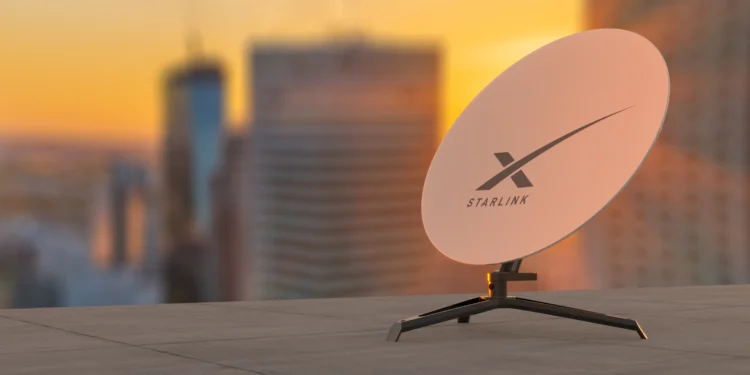
Elon Musk’s Starlink has announced plans for its next-generation mobile connectivity satellites, designed to provide full cellular coverage—including 5G—directly to smartphones.
The company said its upcoming Starlink Mobile V2 satellites will power what it calls the highest-performing satellite-to-mobile network built so far, allowing users to connect seamlessly to mobile networks from virtually anywhere.
The system is intended to complement terrestrial mobile networks and could significantly expand coverage in rural and underserved regions, including Nigeria, where connectivity gaps remain wide.
According to Starlink, the V2 satellites are equipped with custom silicon developed by SpaceX and advanced phased-array antennas capable of supporting thousands of spatial beams. This enables 20 times more throughput compared with the company’s first-generation satellites.
The enhanced capacity means the satellites can provide high-speed mobile connectivity directly to standard smartphones, supporting activities such as video streaming, video calls, podcasts, and remote work.
“In most environments, Starlink Mobile V2 will enable full 5G cellular connectivity with a comparable experience to current terrestrial service,” the company said. The system is designed to integrate with telecom operators’ existing networks, allowing smartphones to switch seamlessly between satellite coverage and ground-based 5G infrastructure without interruption.
Satellite-to-mobile connectivity is emerging as a key innovation in the telecom industry, offering a cost-effective way to expand coverage without requiring traditional cell towers. Unlike standard satellite broadband services that need a dish or terminal, Direct-to-Device (D2D) technology allows ordinary smartphones to connect directly to satellites using existing mobile spectrum.
Nigerian Communications Commission (NCC) has signaled a policy shift toward satellite-powered mobile connectivity in its draft Spectrum Roadmap for 2025–2030, highlighting D2D satellite services as a solution to extend voice and data coverage to signal blackspots, rural, riverine, and border communities. The technology can also act as a fallback during fibre cuts, power outages, or emergencies that disrupt terrestrial networks.
Starlink’s satellite-to-mobile service will be deployed through partnerships with mobile network operators, rather than directly to consumers. In Africa, Airtel Africa signed an agreement last year with SpaceX to deploy Starlink’s Direct-to-Cell technology across its 14 markets, including Nigeria, enabling customers to remain connected even in areas without terrestrial coverage.
Earlier, MTN Group also announced discussions with several satellite providers, including Starlink, as part of its strategy to extend services to underserved areas across its operating regions.