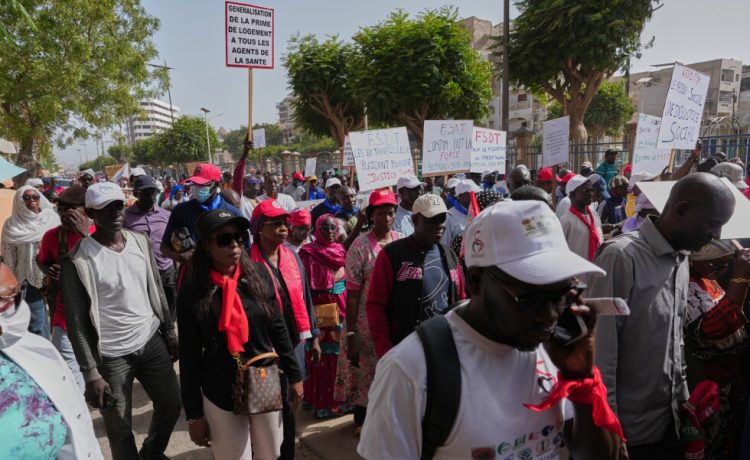
Hundreds of workers, union members, and opposition supporters marched through Dakar on Wednesday to protest what they describe as broken government promises and worsening living conditions, as Senegal grapples with a severe debt crisis.
The demonstration was organized by the country’s main labor unions and the opposition coalition Front for the Defense of Democracy and the Republic (FDR). Mody Guiro, secretary-general of the largest labor union in Senegal, accused the government of reneging on a deal that froze strikes last year in exchange for commitments to better wages and working conditions.
Protesters, wearing red scarves and union hats, held signs demanding the rehiring of laid-off public sector workers and reductions in income taxes. Some called for the resignation of Prime Minister Ousmane Sonko, citing incompetence in handling the country’s economic challenges.
Senegal’s government, led by Sonko and President Bassirou Diomaye Faye since April 2024, promised reforms to fight corruption, create jobs for youth, and maximize the nation’s natural resources. However, a 2025 audit revealed the country inherited a larger-than-reported debt of $13 billion, contributing to stalled talks with the International Monetary Fund and a debt-to-GDP ratio now around 132%, one of the highest in Africa.
The economic strain has particularly affected Senegal’s young population, which makes up about 75% of citizens under 35. Past protests over unpaid financial aid at the nation’s top public university resulted in violent clashes and a student death.
Mohamed Fall, a youth activist participating in Wednesday’s demonstration, said, “The country is at a standstill. It is essential that the government finds solutions to revive Senegal’s economy instead of picking fights everywhere.”
The protest also highlighted discontent over layoffs at the port of Dakar, where over 700 employees have been dismissed since early 2025 amid a government effort to overhaul state institutions. Former port worker Pape Laobe Samb said, “They said they were going to create jobs and develop the country but they did the complete opposite.” Government officials describe the firings as a purge of irregular contracts inherited from the previous administration, while unions argue many dismissals were unlawful.