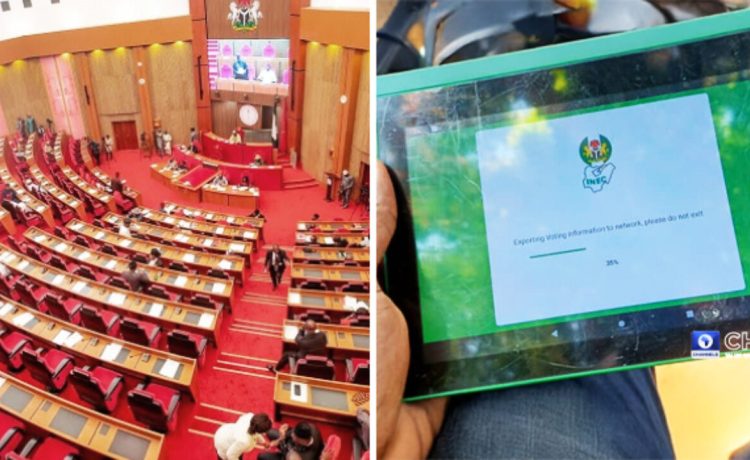
The Senate has passed the Electoral Act 2022 (Repeal and Reenactment) Amendment Bill 2026 following its third reading but rejected a proposed amendment that sought to make the electronic transmission of election results mandatory.
Specifically, the upper chamber declined to amend Clause 60, Subsection 3, which would have compelled presiding officers of the Independent National Electoral Commission (INEC) to electronically transmit polling unit results to the IREV portal in real time after the prescribed Form EC&A had been signed and stamped.
Instead, lawmakers adopted the existing provision of the Electoral Act, which states that “the presiding officer shall transfer the results, including the total number of accredited voters and the results of the ballot, in a manner as prescribed by the Commission.”
Reacting to concerns over the decision, Senate President Godswill Akpabio denied claims that the Senate had rejected electronic transmission of results.
“Electronic transmission has always been in our act,” Akpabio said in his closing remarks. “What we did was retain the existing provision, which already makes provision for electronic transmission.”
He added that there was no attempt by the Senate to delay or frustrate the passage of the Electoral Act.
Earlier, the Senate also rejected a proposed 10-year jail term for the buying and selling of Permanent Voter Cards (PVCs) under Clause 22. Lawmakers instead retained a two-year imprisonment term while increasing the fine from ₦2 million to ₦5 million.
The decision was taken during clause-by-clause consideration of the bill on Wednesday.
In another amendment, the Senate reviewed Clause 28 on the notice of election, reducing the timeline for INEC to publish election notices from 360 days to 180 days before the election date.
Similarly, under Clause 29, lawmakers shortened the deadline for political parties to submit lists of candidates and affidavits from 180 days to 90 days before the election.
The amended clause provides that political parties must submit their candidates’ lists to INEC not later than 90 days before the date appointed for a general election, with candidates emerging from valid party primaries.
The Senate retained Clause 44 on the format of ballot papers, which requires INEC to invite political parties, not later than 20 days before an election, to inspect samples of electoral materials bearing their identities. Parties are allowed two days to indicate approval or disapproval in writing.
Under Clause 47, lawmakers replaced the use of smart card readers with the Bimodal Voter Accreditation System (BVAS) for accreditation and voting. However, after extensive debate, the Senate rejected electronically generated voter identification and retained the Permanent Voter Card as the sole mode of voter identification at polling units.
The upper chamber also struck out Clause 142 on the effect of non-compliance, which sought to remove the requirement for oral evidence in election petitions where documentary evidence clearly showed non-compliance. Lawmakers argued that retaining the clause could lead to unnecessary delays in court proceedings.
Meanwhile, the Senate announced the constitution of a conference committee, to be chaired by Senator Tahir Munguno, to harmonise differences between the Senate and House of Representatives versions of the bill.