The Nigerian Senate has appointed 12 members to collaborate with the House of Representatives on the Electoral Amendment Act, a move aimed at fast-tracking the bill amid recent controversy.
Senate President Godswill Akpabio announced the committee members on Tuesday during an emergency plenary session. Senator Simon Lalong will serve as Chairman, with other members including Senators Orji Uzor Kalu, Tahir Mungono, Adamu Aliero, Abba Moro, Asuquo Ekpenyong, Aminu Iya Abbas, Tokunbo Abiru, Niyi Adegbonmire (SAN), Jibrin Isah, Ipalibo Banigo, and Onyekachi Nwebonyi.
“After consultation with the leadership, we have moved the number from nine to 12. When you meet, you should recognise that this is a matter of urgency,” Akpabio said. “I believe that if you are able to conclude within the next few days or one week, the President should be able to sign the amended Electoral Bill into law within the month of February.”
He added that the committee’s outcome would be promptly transmitted to President Bola Tinubu for assent by the end of February and formally constituted the committee by striking the gavel.
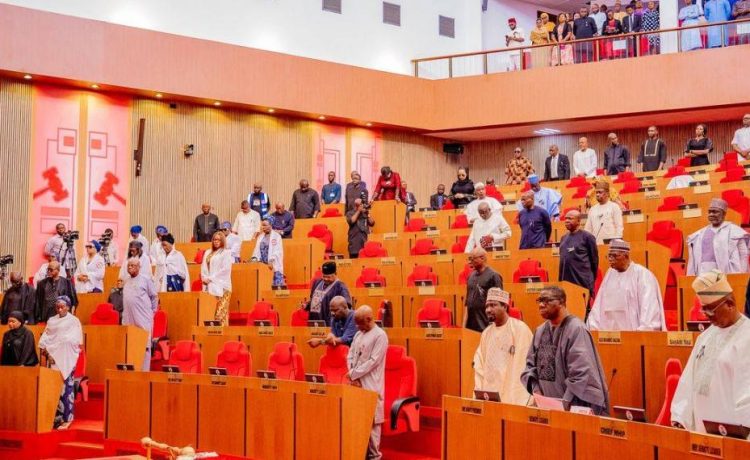
Tensions escalated during the plenary following a point of order raised by Senate Chief Whip, Senator Tahir Monguno (APC, Borno North), who sought rescission of the chamber’s earlier approval of Clause 60(3) of the bill. Monguno’s request, seconded by Senator Abdul Ningi (PDP, Bauchi Central), immediately sparked protests and points of order from several senators.
Disagreement peaked when Monguno read Clause 60(3) without the phrase “real-time,” replacing the word “transmission” with “transfer.” Senator Enyinnaya Abaribe (APGA, Abia South) objected strongly, repeatedly raising points of order as the chamber erupted into shouting.
According to page 45 of the Senate Committee on Electoral Matters report, Clause 60(3) currently states:
“The Presiding Officer shall electronically transmit the results from each polling unit to IREV portal in real time and such transmission shall be done after the prescribed Form EC8A has been signed and stamped by the Presiding Officer and/or countersigned by the candidates or polling agents available at the polling unit.”
At the height of the disagreement, Abaribe invoked Order 72 of the Standing Orders, calling for a division in the chamber.
The appointment of the 12-member conference committee comes as the Senate seeks to resolve contentious issues in the Electoral Amendment Act, including real-time electronic transmission of election results—a provision widely advocated for to ensure transparency and prevent electoral malpractice.