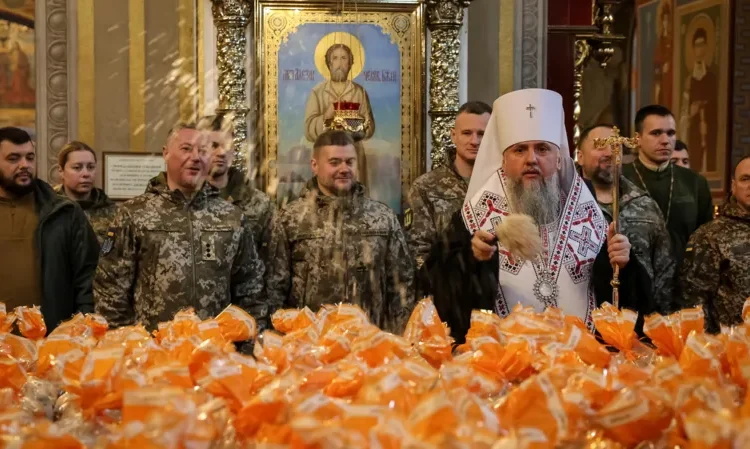
Russia and Ukraine have agreed to a temporary truce for the Orthodox Easter holiday, raising hopes of a brief pause in hostilities in the ongoing war.
Russian President Vladimir Putin announced on Saturday that he had ordered Russian forces to cease fire “in all directions” during the Easter weekend.
According to Moscow, the ceasefire will take effect from 16:00 local time (14:00 BST) on Saturday, April 11, and continue through Easter Sunday.
Putin said the move was intended as a humanitarian gesture and expressed hope that Ukraine would follow Russia’s example.
At the same time, he instructed Russian troops to remain prepared to respond to “possible enemy provocations” or any aggressive actions.
Ukrainian President Volodymyr Zelensky later responded on social media platform X, saying Ukraine was ready to take “symmetrical steps” in response to the truce.
“People need an Easter free from threats and real movement toward peace,” Zelensky wrote. “Russia has a chance not to return to strikes after Easter as well.”
Earlier in the week, Zelensky said he had asked the United States to relay a proposal for a holiday ceasefire to Moscow as an initial step toward de-escalation.
If implemented, the temporary truce would offer a brief respite to soldiers fighting along the long and heavily contested frontlines in eastern Ukraine, where attacks involving drones and artillery have intensified in recent months.
It would also provide relief for civilians across the country, who continue to face frequent air raid sirens and missile strikes.
Recent attacks have underscored the ongoing danger. In the southeastern city of Nikopol, several people were reportedly killed when a drone struck a bus, while in Zhytomyr, west of Kyiv, a woman died after a missile landed near her home.
Despite the announcement of the truce, air raid sirens were reported in Kyiv shortly afterward.
Ukraine has also intensified drone strikes on Russian territory in recent months, targeting energy infrastructure and export facilities. Moscow has claimed that some of these attacks have also damaged residential buildings.
However, many Ukrainians remain sceptical that the ceasefire will hold.
Earlier this year, Russia announced what it described as an “energy truce,” pledging to halt attacks on Ukraine’s power plants during winter. Kyiv later accused Moscow of resuming strikes shortly afterward.
Similarly, a unilateral ceasefire declared by Russia last May to mark the 80th anniversary of the Soviet victory over Nazi Germany was reportedly followed by hundreds of ceasefire violations recorded by Ukrainian authorities.
Ukraine has repeatedly called for a full and stable ceasefire as the first step toward negotiations aimed at ending the war.
Russia, however, has insisted that a broader peace agreement must be negotiated before a permanent halt to fighting can be implemented.
Several rounds of negotiations have previously taken place, with the United States acting as a mediator. However, diplomatic efforts have slowed after former U.S. President Donald Trump shifted his focus toward developments in the Middle East.