The World Health Organisation has suspended operations at its global emergency logistics hub in Dubai following the escalating conflict in the Middle East.
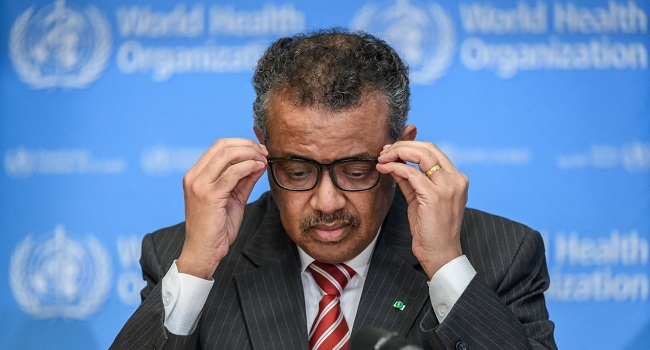
WHO Director-General Tedros Ghebreyesus announced the development on Thursday, warning that the impact of the war goes far beyond the countries directly involved.
The conflict was triggered by coordinated United States and Israeli strikes on Iran last Saturday.
Speaking at a press conference, Ghebreyesus said the worsening security situation had forced the agency to halt activities at the key logistics centre.
“Operations at WHO’s logistics hub for global health emergencies in Dubai are currently on hold due to insecurity,” he said.
The Dubai hub plays a crucial role in global humanitarian response operations.
According to the WHO’s Eastern Mediterranean Regional Director, Hanan Balkhy, the facility processed more than 500 emergency supply orders for 75 countries in the past year alone.
She warned that the ongoing disruption is now threatening global humanitarian health supply chains.
Balkhy explained that operations at the hub have been temporarily halted because of insecurity, airspace closures and restrictions affecting access to the Strait of Hormuz.
The situation is preventing access to about $18 million worth of humanitarian health supplies stored at the facility.
Another $8 million worth of shipments is also unable to reach the hub due to transport restrictions.
The disruption is affecting more than 50 emergency supply requests from 25 countries.
It is also delaying the delivery of around $6 million worth of medicines intended for the Gaza Strip, which has been heavily affected by ongoing conflict.
In addition, $1.6 million in polio laboratory supplies are currently being held up, raising concerns about potential setbacks in polio eradication efforts in Afghanistan and Pakistan, where the disease remains endemic.
Balkhy said the WHO is working closely with authorities in the United Arab Emirates to find ways to resume operations at the hub.
The organisation is also exploring alternative supply routes through other humanitarian logistics centres located in Nairobi, Dakar and Brindisi.
She added that if the conflict continues for an extended period, the WHO may consider alternative land routes, possibly through Saudi Arabia, to ensure critical medical supplies reach affected regions.
Despite the contingency plans, Balkhy stressed that the Dubai logistics hub remains a vital component of the global humanitarian response system.
“The Dubai hub is an extremely important lifeline for the humanitarian response,” she said.