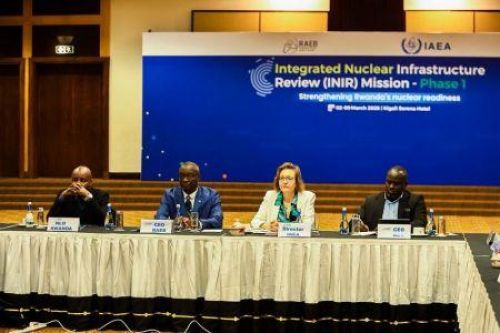
Rwanda is making significant strides in its civil nuclear energy program, the International Atomic Energy Agency (IAEA) has concluded following an infrastructure review in Kigali in early March.
The mission, known as the Integrated Nuclear Infrastructure Review (INIR), took place from March 2 to March 9, 2026, evaluating Rwanda’s readiness across 19 essential areas, including legal frameworks, nuclear regulation, radioactive waste management, safety, security, and human resource development. The review was conducted at the request of the Rwandan government.
IAEA experts observed “a strong commitment from the government” and noted that authorities have initiated institutional coordination to introduce nuclear energy into Rwanda’s power mix. The review also highlighted progress in preparing national systems to manage nuclear and radiological emergencies.
The mission offered several recommendations, urging Rwanda to finalize its nuclear legal framework and continue developing a comprehensive energy strategy that integrates nuclear power. Experts also recommended preparing a detailed national report to guide government decision-making regarding nuclear energy deployment.
Rwanda’s civil nuclear program is being implemented through the Rwanda Atomic Energy Board (RAEB) and follows an IAEA roadmap for countries pursuing nuclear power. The country’s efforts coincided with the World Nuclear Energy Summit in Paris on March 10, where Paul Kagame reiterated Rwanda’s commitment to nuclear technology as part of its long-term energy strategy.
Hydropower currently dominates Rwanda’s energy mix, but authorities anticipate a medium- to long-term gap between electricity supply and demand, prompting the diversification plan. Rwanda has been developing its nuclear program since 2018, when it signed a memorandum of understanding with Russia to collaborate on civil nuclear energy through the state company Rosatom. This partnership covers specialist training, nuclear infrastructure development, and nuclear plant project exploration.
The cooperation was strengthened in June 2020, when the Rwandan parliament ratified the agreement, providing a legal framework for implementation. In September 2023, Rwanda expanded technological partnerships by signing an agreement with the German company Dual Fluid to build an experimental reactor testing advanced “Dual Fluid” technology.
“We are working with the objective of having a first unit producing electricity in Rwanda at the beginning of the 2030s,” said Fidele Ndahayo.