Recent elections in Guinea have taken place against the backdrop of an open-ended political transition following the overthrow of President Alpha Condé in September 2021.
The transition, led by the National Committee of Reconciliation and Development (CNRD), has been characterised by political tensions, repeated delays to the electoral calendar and heightened public expectations for a return to constitutional rule.
Beyond the political uncertainty, social pressures remain acute. Inflation, estimated at 5.1 per cent in 2024 by the World Bank, continues to erode household purchasing power. While official unemployment figures range between 4.5 per cent and 5.8 per cent, analysts note that these numbers mask widespread informality and job insecurity, particularly among young people.
Poverty levels remain high, with nearly 52 per cent of the population living below the international poverty line of 3.65 dollars per day (PPP). About 1.8 million people are reported to have recently fallen into poverty, reflecting the depth of the country’s social challenges.
These difficulties are compounded by stark regional and gender disparities, as well as a persistently high illiteracy rate. According to the National Institute of Statistics, cited by the Ministry of Pre-University Education and Literacy (MEPUA) in 2024, Guinea’s illiteracy rate stands at 68 per cent, with women in rural areas disproportionately affected.
Economically, Guinea has recorded strong growth in recent years, largely driven by the mining sector. Real Gross Domestic Product (GDP) grew by 7.1 per cent in 2023 and an estimated 5.7 per cent in 2024. The outlook remains positive, with growth projected at around 6.5 per cent in 2025 and the possibility of double-digit expansion in the medium term, supported by the development of the Simandou iron ore project.
However, the benefits of this growth have not been widely shared. Formal job creation remains limited, public revenue mobilisation is low at approximately 13 per cent of GDP, and the economy remains heavily dependent on raw material exports.
Observers say the central challenge for the authorities will be to transform mining-led growth into sustainable development, increased employment and productive investment across other sectors of the economy.
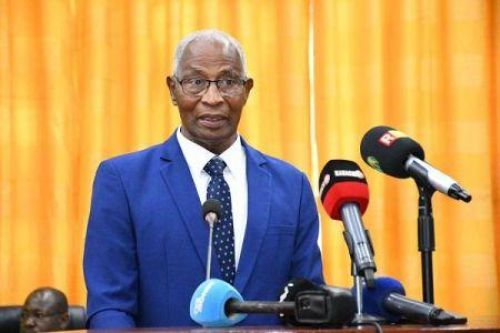
Against this backdrop, Prime Minister Amadou Bah Oury on Wednesday, February 4, 2026, unveiled a new government tasked with addressing Guinea’s structural challenges and laying the foundations for sustainable and inclusive growth under President Mamadi Doumbouya.
Within the new cabinet, attention is expected to focus on the effectiveness of public policy implementation. While responsibility rests with the entire executive, particular pressure will fall on Finance Minister Mariama Ciré Sylla, who is widely seen as pivotal to driving fiscal reforms and translating political ambition into tangible economic outcomes.