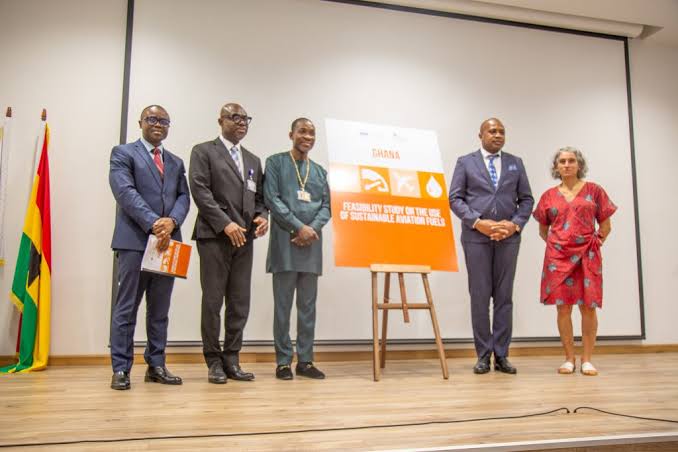
The Ghana Civil Aviation Authority (GCAA) has launched feasibility and business implementation studies on sustainable aviation fuel (SAF), aiming to accelerate the country’s aviation sector transition to net-zero carbon emissions by 2050, in alignment with targets set by the International Civil Aviation Organization (ICAO).
At a two-day SAF workshop beginning February 24, 2026, GCAA Director-General Rev. Stephen Wilfred Arthur described the initiative as a “significant milestone in Ghana’s journey towards a greener and more resilient aviation sector.” He emphasised that the focus has moved beyond research into the critical stage of business implementation, integrating national policy, certification frameworks, and fuel-supply standards with ICAO guidance.
Supported by ICAO’s ACT-SAF programme and funded by the UK Department for Transport, the feasibility study highlights Ghana’s potential to develop a SAF industry due to abundant agricultural residues, existing refining infrastructure, and regional trade linkages. Challenges remain in feedstock mobilisation and cost competitiveness, which will require coordinated policy and investment frameworks to attract industry participation.
Officials note that SAF, produced from renewable feedstocks such as agricultural waste rather than conventional fossil fuels, can reduce lifecycle carbon emissions from aircraft by up to 80%. Its production could also diversify fuel supply, stimulate new agricultural and energy value chains, and create economic opportunities, including repurposing cocoa husks and other biomass into value-added products.
Ghana’s SAF initiative positions the country as a leading African state in sustainable aviation planning, supporting ICAO’s 2026–2050 strategic plan, which promotes cleaner fuels, operational efficiency, and harmonised international standards.