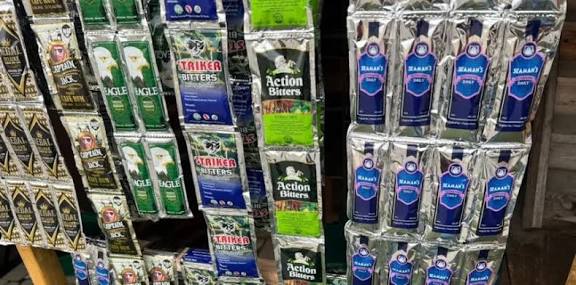
The Federal Government has directed the National Agency for Food and Drug Administration and Control (NAFDAC) to suspend all enforcement actions relating to the proposed ban on sachet alcohol and 200ml PET bottle alcoholic products.
The directive also instructs the agency to immediately stop sealing factories and warehouses over the issue.
This was disclosed in a statement issued on Wednesday in Abuja by the Special Adviser on Public Affairs to the Secretary to the Government of the Federation (SGF), Terrence Kuanum.
According to the statement, the decision followed a joint intervention by the Office of the SGF and the Office of the National Security Adviser (NSA), which raised concerns about the security implications of continued enforcement in the absence of a fully implemented National Alcohol Policy.
“Accordingly, all actions, decisions, or enforcement measures relating to the ongoing ban on sachet alcohol are to be suspended pending the final consultations and implementation of the National Alcohol Policy and the issuance of a final directive,” the statement read.
Although the National Alcohol Policy has been signed by the Federal Ministry of Health in line with President Bola Tinubu’s directive, the government insisted that NAFDAC must refrain from enforcement measures until the policy is fully implemented and further guidance is issued.
The suspended measures include factory shutdowns, sealing of warehouses, and public emphasis on the sachet alcohol ban.
The government warned that continued sealing of warehouses and what it described as a “de facto ban” without a harmonised policy framework was already causing economic disruptions and posing security risks, particularly due to its impact on jobs, supply chains, and informal distribution networks nationwide.
Kuanum noted that the position reinforces an earlier directive issued by the SGF’s office in December 2025, which had suspended actions relating to the proposed ban pending consultations and a final decision.
He added that the SGF’s office also received a letter dated November 13, 2025, from the House of Representatives Committee on Food and Drugs Administration and Control, raising concerns about NAFDAC’s enforcement plans and referencing existing National Assembly resolutions on the matter. The letter, referenced NASS/10/HR/CT.53/77 and signed by Deputy Chairman Hon. Uchenna Okonkwo, urged caution over the proposed actions.
The Federal Government said it is currently reviewing legislative resolutions, public health considerations, economic implications, and broader national interest factors surrounding the issue.
It added that the involvement of the National Security Adviser underscores that the matter has moved beyond regulatory concerns, warning that premature enforcement without coordinated policy implementation could destabilise communities, worsen unemployment, and trigger security challenges.
The government assured Nigerians and industry stakeholders that a final decision would be communicated after consultations and inter-agency coordination, in the interest of public health, economic stability, and national security.