The Federal Government of Nigeria has stepped up efforts to expand access to globally recognised education by announcing plans to establish a local campus of Coventry University in Nigeria through a transnational education partnership.
The initiative, led by the Federal Ministry of Education Nigeria, is designed to enable Nigerian students to earn United Kingdom-accredited degrees without leaving the country. Officials say the move will significantly reduce the cost of overseas education and help curb capital flight.
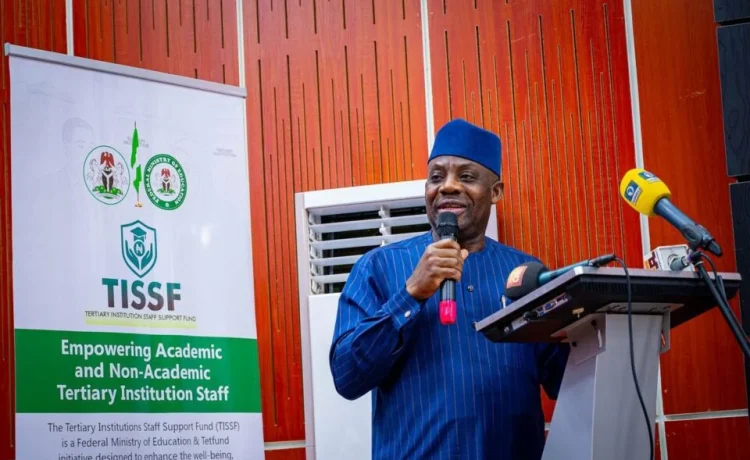
Minister of Education, Maruf Alausa, disclosed the development in a statement on Wednesday. He noted that discussions are ongoing with key stakeholders in the United Kingdom to fast-track the project.
Alausa, who is currently in the UK alongside Bola Tinubu, said engagements are underway with university leaders, investors, and development partners to bring the initiative to fruition.
According to him, the proposed campus will be located in Alaro City, a rapidly growing education and economic hub in Lagos State.
The university is expected to offer undergraduate and postgraduate programmes across key disciplines, including Science, Technology, Engineering, Mathematics, Medicine, Business, and Technical and Vocational Education and Training.
“All degrees offered will be equivalent to those awarded in the United Kingdom,” the minister stated, adding that admissions may begin between the third and fourth quarters of 2026, subject to regulatory approvals.
He emphasised that the initiative would ease financial pressure on Nigerian families while improving access to quality education. “We want Nigerian parents to enjoy their children being at home while still receiving a world-class UK education,” he said.
Nigeria has seen a steady rise in the number of students seeking education abroad, particularly in the United Kingdom, Canada, and United States. This trend has been driven by the perceived quality of foreign institutions and frequent disruptions in the domestic university system.
Recent data from UK authorities indicate that tens of thousands of Nigerian students enrol in British universities annually, placing Nigeria among the largest sources of international students to the UK.
However, the depreciation of the naira in recent years has sharply increased the cost of tuition, accommodation, and living expenses abroad, making foreign education less accessible for many families.
Analysts have also linked the surge in outbound students to recurring strikes by university unions, infrastructure challenges, and limited admission capacity within Nigeria’s tertiary institutions.
The Central Bank of Nigeria has previously highlighted the growing demand for foreign exchange for education as a factor putting pressure on the country’s external reserves.
Officials say the proposed campus aligns with the government’s broader strategy to promote transnational education, allowing foreign universities to deliver programmes locally. The model is expected to help retain talent, reduce brain drain, and build capacity in critical sectors such as technology, healthcare, and engineering.
The partnership is being supported by the UK Department for Business and Trade, reflecting deepening cooperation between Nigeria and the UK in education and skills development.
Experts note that similar initiatives in countries like the United Arab Emirates and Malaysia have successfully attracted international universities and transformed those nations into regional education hubs.