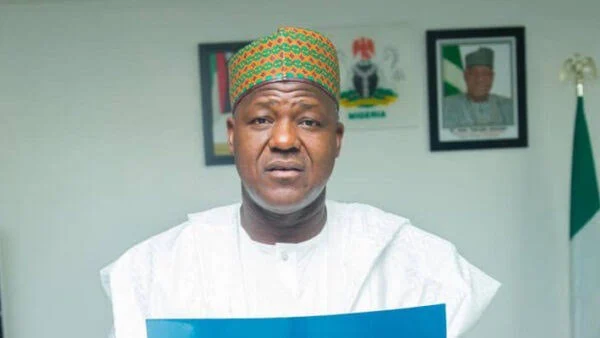
Former Speaker of the House of Representatives, Yakubu Dogara, has expressed support for President Bola Ahmed Tinubu, insisting that minority voices continue to be heard in Nigeria’s democracy despite political alignments and ongoing debates over rotational presidency.
Speaking on Channels Sunday Politics in Abuja on Sunday, Dogara said concerns that rotational presidency undermines merit and competence are misplaced.
“The concern will always be that if you go for rotational presidency, then the thing you are compromising may be merit and competence. But that is not true, because there is hardly any area of human endeavour where you cannot find someone from the North who is competent or someone from the South who is competent,” he said.
Dogara stressed that fairness and national unity should guide the application of rotational leadership, noting that competence exists across all regions of the country.
On the establishment of the Forum of Former Members of the Legislature, which he recently attended, Dogara said the initiative was created to harness the experience and skills acquired by former lawmakers during their years of public service.
He explained that the forum brings together former senators, members of the House of Representatives, state assembly members and councillors from all 774 local government areas.
“The overriding purpose of establishing the forum is to harness all the skills members acquired while serving the nation,” he said, adding that former legislators have a responsibility to defend democratic values at a time they are under threat globally.
Dogara also highlighted what he described as tangible achievements of the Tinubu administration, particularly in infrastructure and security, citing developments in the North-East.
He recalled a visit to the Mandara Plateau, where President Tinubu initiated the construction of a road linking Gembu to Yumguni near the Cameroonian border—an infrastructure project that had remained unfulfilled since the 1961 plebiscite.
“This was a region dominated by treacherous terrain. It used to take six hours from Gembu to the headquarters of Sardauna Local Government and to the Cameroonian border. When the road is completed, the journey will take about 45 minutes. That is leadership,” he said.
On security, Dogara said there were signs of improvement in the North-East, pointing to increased road traffic and movement of people during the Christmas period as an indication of growing public confidence.
“I have never seen this kind of traffic into the North-East in 15 years. It means people are beginning to have faith in improvements in security. People who had fled are now returning during holidays,” he said.
While reaffirming his support for Tinubu, Dogara emphasised that Nigeria remains a democracy where dissenting opinions are respected.
“We haven’t stopped anyone from expressing contrary views. Nigeria is a democracy. We’ve stated our position and our reasons. We are open to listening to others,” he said.
He also addressed concerns about the marginalisation of Christians in parts of Northern Nigeria, describing it as an issue that varies from state to state.
“In some parts, yes. In others—Plateau, Benue, Taraba, Nasarawa—you cannot say Christian voices are drowned. Victimisation is a state-by-state issue. But Christians and Muslims working together can resolve it,” he said.
Responding to speculation about a possible role as Tinubu’s running mate in 2027, Dogara dismissed the idea, saying decisions should be based on principle rather than fear or political pressure.
“Whatever we do should not be because we are afraid of anybody. It should be because it is the right thing to do,” he said.
He concluded by calling for greater religious and regional unity, recalling his emergence as Speaker of the House as an example of cooperation across faith lines.
“I want to see Muslims defend Christians and Christians defend Muslims. That unity is what we need to rebuild the North and Nigeria,” Dogara said.