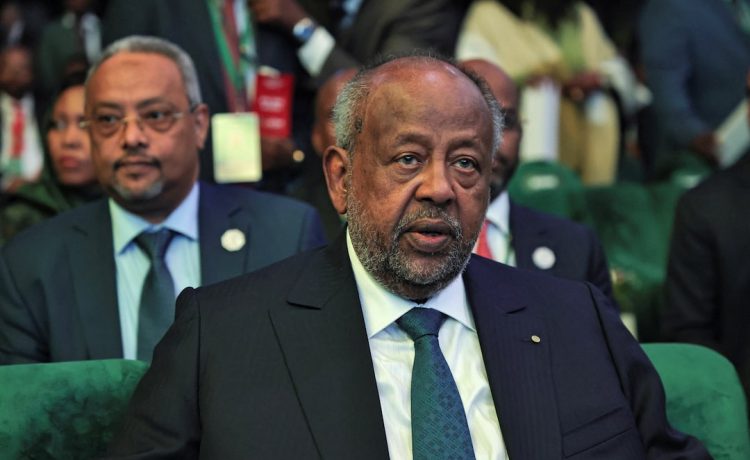
Djibouti heads to the polls on Friday in a presidential election widely expected to extend the nearly three-decade rule of incumbent Ismael Omar Guelleh.
Guelleh, 78, has led the strategically located Horn of Africa nation since 1999 and is seeking another term after constitutional changes removed age limits that would previously have barred him from running.
The country, which has a population of fewer than one million people, sits along the Gulf of Aden at the entrance to the Red Sea and holds significant geopolitical importance due to its location and foreign military presence.
Djibouti hosts military bases operated by the United States, China, France, Italy, and Japan, making it one of the most militarised diplomatic hubs in Africa.
The nation has also gained increased maritime relevance since 2023, as several commercial vessels damaged in attacks by Yemen’s Houthi Movement have sought refuge in its ports.
Guelleh assumed office after being selected to succeed his uncle, Hassan Gouled Aptidon, who became Djibouti’s first president following independence from France in 1977.
Under his leadership, Djibouti has invested heavily in port infrastructure and positioned itself as the primary trade gateway for landlocked Ethiopia, one of Africa’s fastest-growing economies.
In the current election, Guelleh faces only one challenger, Mohamed Farah Samatar of the small Unified Democratic Centre (CDU), a party with no parliamentary representation.
Guelleh has won five previous elections, each time securing at least 74 percent of the vote, including more than 97 percent in the 2021 election.
Speaking ahead of the vote, he defended his long tenure, saying the country had maintained stability in a volatile region.
“Let us remember we have managed to maintain the stability of our country in an unstable region. We have preserved peace when others have descended into chaos,” he said.
However, human rights organisations have repeatedly accused Djibouti’s authorities of suppressing opposition voices, activists, and journalists.
Two major opposition parties have boycotted elections since 2016, citing concerns over electoral fairness and lack of institutional independence.
The government has consistently denied allegations of political repression and maintains that elections are conducted transparently.
Samatar has campaigned on promises to tackle corruption, reduce government spending, and increase investment in social services, according to local reports.
In 2020, rare anti-government protests were dispersed by security forces following the arrest of a former air force pilot who had accused officials of corruption and clan-based discrimination.
Last October, lawmakers removed the presidential age limit of 75 and scrapped the requirement for a referendum to approve constitutional changes, paving the way for Guelleh’s continued eligibility.
Despite criticism, Djibouti remains one of the most politically stable countries in the Horn of Africa, a factor that continues to attract foreign military and commercial interests.