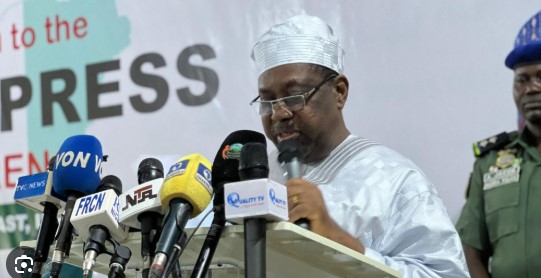
The Federal Government has announced plans to train at least 100 million Nigerians in digital literacy, unveiling a new nationwide programme in partnership with Clergywealth Cooperative Society Limited.
Officials say the initiative is designed to deliver foundational digital skills, promote online safety, and prepare citizens for emerging technologies, including artificial intelligence. The programme is tied to the National Conference on Digital Literacy and will be implemented through a joint committee inaugurated by both partners.
The announcement was made during the inauguration of the joint implementation committee, where government representatives stressed that the programme is privately funded and aligned with Nigeria’s broader digital economy agenda.
According to the implementation framework presented at the event, the first phase targets the training and certification of one million Nigerians. Graduates are expected to receive international certifications and, in some cases, laptops to support continued learning and productivity.
Government officials described the partnership with Clergywealth Cooperative as a strategic move to leverage community networks and privately mobilised resources to deepen digital inclusion.
They noted that Nigeria’s youthful population requires urgent upskilling to remain competitive in an era increasingly defined by remote work, e-commerce, and AI-powered services.
On paper, the programme is ambitious in scope and content. It covers basic computer operations, internet navigation, digital financial services, cybersecurity awareness, and technology-driven entrepreneurship.
The curriculum also introduces learners to AI tools, data analytics, and creative digital industries, areas seen as new frontiers for job creation.
Organisers of the initiative argue that the plan will help “future-proof” Nigeria’s economy by expanding the pool of digitally competent workers and small business owners.
They added that the distribution of laptops would remove one of the major barriers to participation for low-income households.
The government further explained that the programme supports existing national policies aimed at transforming Nigeria into a leading digital talent hub in Africa.
Officials said the conference would provide a platform for aligning private sector efforts with public goals and international standards.
However, the scale of the 100-million target has raised familiar questions among policy analysts and citizens.
Nigeria has launched several digital skills initiatives across ministries, agencies, and development partners in recent years, many with overlapping objectives.
Experts say training nearly half the population will require far more than policy alignment and headline numbers.
They point to the need for clear delivery timelines, transparent metrics, sustainable infrastructure, and independent oversight to ensure credibility.
Digital learning in Nigeria continues to battle challenges around electricity, internet access, qualified instructors, and regional inequality.
While privately funded, the programme will still depend heavily on public assets, such as schools, community halls, and broadband infrastructure.
Stakeholders at the event acknowledged that coordination will be central to success.
They promised that the joint committee would publish implementation updates and adopt measurable indicators tied to employment and entrepreneurship outcomes.
For many Nigerians, the promise of international certifications and laptops sounds familiar.
Past programmes have often celebrated enrolment figures without demonstrating how many graduates gained usable, income-earning digital skills.
Analysts insist that the real test will not be how many Nigerians are enrolled, but how many actually complete training, receive quality instruction, and convert skills into jobs or businesses.
The organisers expressed confidence that the Clergywealth network would help reach underserved communities, including women, rural youths, and informal workers.
They also hinted at plans to engage global certification bodies and technology manufacturers to support the scheme.
If achieved, the programme could mark one of the largest digital literacy interventions in the developing world.
Nigeria’s ambition to build AI-era capacity is widely seen as necessary, but citizens will be watching for concrete impact beyond committee inaugurations and conference speeches.
The National Conference on Digital Literacy is expected to outline further details on funding flows, partner roles, and certification pathways in the coming months.
Until then, the country once again stands between bold promises and the harder work of execution.