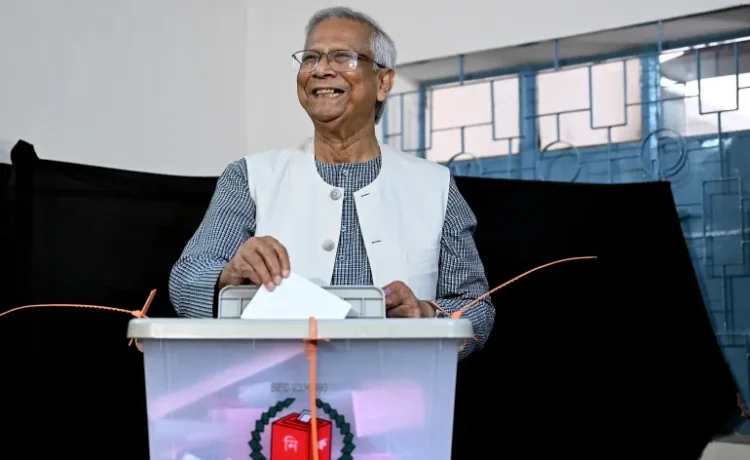
Voters across Bangladesh participated in parliamentary elections on Thursday, signaling a critical moment for the country’s democracy after a period of intense political unrest and violence.
Polling began slowly but picked up by mid-morning in the capital Dhaka and nationwide, with results expected on Friday. More than 127 million eligible voters are participating in the first election since the 2024 ouster of former Prime Minister Sheikh Hasina, who fled to India after widespread protests and a brutal crackdown that left hundreds of young demonstrators dead. Hasina has been sentenced to death in absentia and her party was barred from the vote.
The frontrunner to form the next government is Tarique Rahman of the Bangladesh Nationalist Party (BNP). Returning from 17 years in exile in London, Rahman has pledged to restore democratic institutions, uphold the rule of law, and tackle the country’s economic challenges.
Challenging the BNP is an 11-party coalition led by Jamaat-e-Islami, Bangladesh’s largest Islamist party, which has expanded its influence since Hasina’s removal. Jamaat-e-Islami leader Shafiqur Rahman expressed confidence in the election, stating, “People demand change. They desire change. We also desire the change.”
The election is overseen by an interim government headed by Nobel laureate Muhammad Yunus, ensuring a fair and transparent process. About 500 international observers and foreign journalists, including delegations from the European Union and Commonwealth, are monitoring the polls.
Bangladesh’s 350-seat Parliament has 300 directly elected members and 50 seats reserved for women. One constituency’s vote was postponed after a candidate’s death, leaving 299 seats contested. First-time voters, particularly the five million young people who drove the 2024 uprising, are expected to play a decisive role.
The outcome of Thursday’s election could fundamentally reshape Bangladesh, a country whose history since independence in 1971 has been marked by political instability, military interventions, and contested elections.