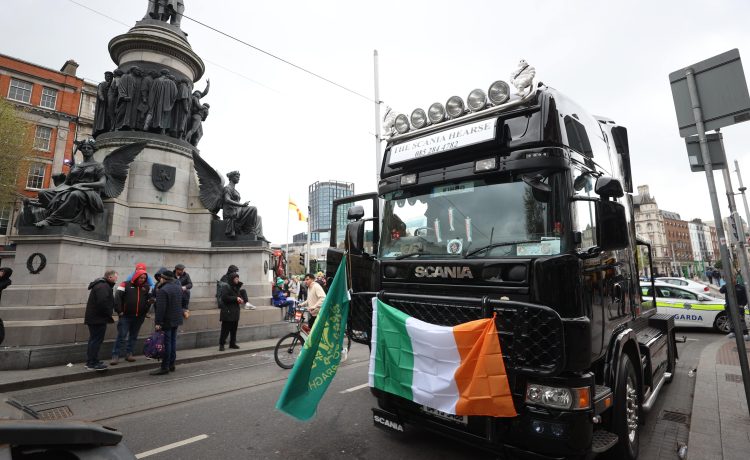
The Irish government was scheduled to hold an emergency cabinet meeting on Sunday to approve measures aimed at ending nationwide fuel cost protests that have begun to disrupt the country’s critical services.
The demonstrations began on Tuesday when hauliers and agricultural contractors launched protests over rapidly rising petrol and diesel prices linked to the ongoing Middle East conflict. What started as slow-moving convoys on major motorways and restrictions on access to busy streets in Dublin has since escalated into broader disruptions.
Protesters have partially blockaded Ireland’s only oil refinery at Whitegate Refinery and restricted access to at least two other fuel depots. The disruptions have contributed to fuel shortages across the country, with many petrol stations reporting empty pumps.
The government has urged the public not to panic buy fuel as supplies remain under pressure.
Irish authorities moved on Saturday to restore access to key infrastructure. Police, supported by the armed forces, deployed public order units to clear the blockade at Whitegate Refinery in southern Ireland.
Irish police chief Justin Kelly said the operation was carried out as a last resort after the protests began threatening essential services.
According to Kelly, the blockade of critical national infrastructure had led to fuel shortages that were directly affecting emergency services, including hospitals, ambulance operations, and fire services.
Authorities also dismantled a makeshift barrier set up by protesters at the docks in Galway. In a separate late-night operation, police cleared vehicles — including tractors and lorries — that had blocked O’Connell Street, one of the busiest streets in Dublin.
Justice Minister Jim O’Callaghan condemned the continuation of the protests despite the growing national impact.
He acknowledged the pressure that rising fuel costs have placed on workers and businesses but insisted that no group has the right to disrupt the country in such a manner.
Earlier in March, the Irish government introduced a €250 million package aimed at easing fuel costs. The measures included a diesel rebate specifically designed to support road hauliers.
Finance Minister Simon Harris said ministers had held discussions with representatives from the transport and agriculture sectors on Saturday ahead of the emergency meeting.
According to a government statement, officials are finalising a “significant support package” intended to resolve the crisis and bring an end to the protests.
Meanwhile, Ger Hyland said negotiators were close to reaching an agreement with the government.
Hyland noted that discussions had produced the “bones of an agreement” and expressed hope that a final deal could be reached either late Saturday or on Sunday.
As the protests entered their sixth day, the government is hoping the proposed support measures will ease tensions and restore normal fuel distribution across the country.