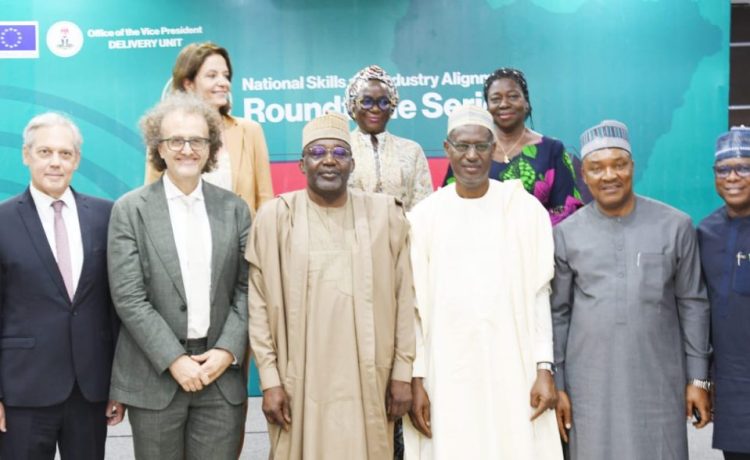
The administration of Bola Ahmed Tinubu has called on global development partners, policymakers, and industry leaders to deepen investments in the Federal Government’s skills acquisition programmes aimed at empowering millions of Nigerian youths.
The appeal was made on Tuesday during the National Skills and Industry Alignment Roundtable Series (Q1 2026) held in Abuja. The event, themed “Bridging Skills Supply and Labour Market Demand,” was convened by the Office of the Vice President with support from the European Union.
Declaring the roundtable open, Vice President Kashim Shettima urged stakeholders to prioritise clarity, collaboration, and coordinated action in building a stronger national workforce system.
Shettima, who was represented by the Deputy Chief of Staff to the President (Office of the Vice President), Ibrahim Hassan Hadejia, said Nigeria must develop a coherent framework where skills training leads directly to employment and enterprise.
He commended the European Union for its continued partnership with Nigeria in advancing youth development and job creation initiatives.
According to the Vice President, Nigeria stands at a critical point in its development journey, as millions of young people enter the labour market each year with ambition and potential.
However, he noted that many available jobs remain informal and unstable, limiting productivity and economic growth.
“This tells us one thing clearly—the challenge is not simply job creation; it is alignment. Nigeria does not have a talent problem. Until skills meet industry demand, job creation will remain below its full potential,” Shettima said.
He stressed that the Tinubu administration is shifting away from fragmented programmes and uncoordinated investments toward a unified national system.
“We are moving toward a system where skills lead to jobs, jobs lead to enterprise, and enterprise drives economic growth,” he said.
The Vice President also highlighted earlier efforts by his office, supported by the European Union, to map Nigeria’s job creation ecosystem and organise a National High-Level Policy Dialogue on Job Creation.
He said the findings from the dialogue underscored that sustainable employment cannot come from government alone but requires a coordinated ecosystem where the private sector plays a leading role while government provides enabling policies.
Shettima explained that the roundtable series was designed to create a structured platform for policymakers, development partners, and industry leaders to align their efforts and develop practical solutions.
“Job creation cannot be outsourced to government alone. Industry must sit at the table not just as employers but as co-creators of the workforce Nigeria needs,” he said.
He also urged development partners to focus not only on funding programmes but on improving coordination and scaling successful initiatives.
Earlier, the Minister of Housing and Urban Development, Ahmed Musa Dangiwa, said the initiative is important for sectors like housing where skilled labour is urgently needed.
Dangiwa noted that housing development requires collaboration across a broad chain of professionals, including architects, engineers, and artisans.
He added that strengthening skills development in the sector would help address Nigeria’s housing deficit while stimulating economic growth.
Meanwhile, the EU Head of Cooperation for Nigeria and ECOWAS, Massimo De Luca, highlighted ongoing partnerships between the EU and the Office of the Vice President.
He said the EU has been focusing on strengthening Nigeria’s production systems by supporting skills development initiatives tied to real economic needs.
De Luca also commended the Vice President’s office for integrating fellowship programmes such as 3 Million Technical Talent Programme into a broader national ecosystem.
The Senior Special Assistant to the President on Delivery and Coordination, Akubo Adegbe, described the roundtable as part of an ongoing effort to improve coordination across Nigeria’s job creation ecosystem.
He said the platform would help stakeholders move beyond discussions toward measurable outcomes in priority sectors of the economy.
Participants at the roundtable included representatives from the organised private sector, the German Agency for International Cooperation, the Tony Elumelu Foundation, and the Aliko Dangote Foundation.