A waste and environmental sustainability expert, Olufemi Idowu-Adegoke, has identified poor plastic waste management as a major contributor to flooding in Lagos.
Speaking in an interview with the News Agency of Nigeria on Tuesday, Adegoke called for a transition from a disposal-driven system to a circular economy anchored on recycling.
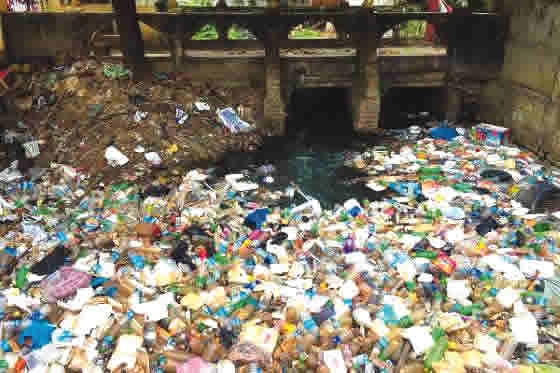
He revealed that Lagos generates over 13,000 tonnes of waste daily, with plastics such as sachet water, nylon, and bottles forming a large portion. According to him, these materials often end up in drainage channels, canals, and lagoons, where they block water flow and trigger flash flooding during rainfall.
“Plastics are lightweight and non-biodegradable. When not captured by recycling systems, they are easily washed into drains and remain in the environment for decades,” he said.
Adegoke noted that capturing between 30 and 50 per cent of plastic waste could significantly reduce flooding and environmental degradation in the state.
He acknowledged efforts by the Lagos Waste Management Authority, stating that the agency has built a solid institutional framework since its establishment in 1977. This includes structured waste collection, regulation of private operators, and public awareness campaigns.
He added that recent initiatives such as material recovery facilities, partnerships with recyclers, and educational programmes have improved awareness. However, he stressed that the impact remains limited due to systemic and policy gaps.
According to Adegoke, plastic recycling rates in Lagos remain between three and six per cent, while other recyclable materials record less than five per cent recovery. He added that only about 40 per cent of total waste generated is formally collected.
“The system is still largely ‘collect, transport and dump,’ with heavy reliance on landfill sites instead of recycling,” he said.
He identified weak enforcement of environmental policies, lack of mandatory waste sorting, and limited economic incentives as key challenges.
“Lagos does not lack policies; it lacks consistent enforcement, economic incentives and system integration,” he added, warning that the state is approaching a tipping point due to rising population and consumption levels.
Adegoke called for urgent reforms, including scaling up recycling through coordinated actions across policy, infrastructure, finance, and public behaviour. He recommended decentralising recycling infrastructure and strengthening community-based recovery systems.
He also emphasised the need to formalise and empower informal waste workers through registration, licensing, and social protection.
“These actors are the backbone of recycling and must be recognised as part of the green workforce,” he said.
The expert further advocated stronger economic incentives such as deposit return schemes, expansion of Extended Producer Responsibility, tax credits for recycled materials, and import duty waivers on recycling equipment.
He also called for increased investment in local processing capacity, including bottle-to-bottle plants and plastic manufacturing systems, stressing that recycling must become more profitable than dumping.
On investment strategy, Adegoke urged policymakers to adopt life-cycle cost analysis in waste management decisions. He explained that although recycling infrastructure requires higher upfront costs, it offers long-term economic and environmental benefits.
“Recycling converts waste to value through material recovery, manufacturing and carbon credits,” he said, contrasting it with landfill systems, which he described as recurring liabilities with little revenue potential.
He also highlighted challenges facing recyclers, including irregular waste supply, high logistics costs, limited access to finance, and weak policy enforcement. He noted that logistics alone can account for up to 50 per cent of recycling operating costs in Lagos.
To address these issues, Adegoke recommended creating a recycling registry, establishing cooperatives, providing targeted financing, and developing dedicated recycling zones.
He concluded by urging Lagos to shift from a “pay-to-dump” model to a value recovery system.
“Lagos is still paying heavily for disposal instead of investing in recovery,” he said, adding that the state already has a functional recycling workforce that only needs to be formalised, empowered, and scaled.