Nigeria has taken a major step toward strengthening its healthcare sector following a landmark €50 million financial agreement between the Bank of Industry and EIB Global.
The deal was announced on the sidelines of the Nigeria-EU Ministerial Summit held in Abuja on Monday. It is designed to boost local manufacturing of vaccines, pharmaceuticals, and diagnostic tools across the country.
The €50m facility provides long-term patient capital to help reduce Nigeria’s dependence on imported medical supplies while improving national health security. It also aims to support local manufacturers in scaling production and meeting international standards.
Managing Director and Chief Executive Officer of the Bank of Industry, Olasupo Olusi, described the agreement as a transformative move for the country’s industrial and healthcare landscape.
“This partnership marks a pivotal step in Nigeria’s journey from being a major importer of essential health commodities to becoming a competitive producer within regional and global value chains,” he said.
Olusi added that the initiative aligns with the economic agenda of Bola Tinubu, particularly in building national resilience, creating jobs, and strengthening critical sectors.
The investment forms part of the European Union’s Global Gateway strategy and is targeted at addressing unmet medical needs. It will provide dedicated financing support to local pharmaceutical, vaccine, and diagnostic manufacturers.
Vice President of the European Investment Bank, Ambroise Fayolle, said the partnership would improve access to affordable and high-quality healthcare products in Nigeria.
“I am pleased to announce this partnership with the Bank of Industry to improve public health and daily lives in Nigeria,” Fayolle stated, adding that the initiative would enhance supply chain resilience.
Also speaking, European Commissioner for International Partnerships, Jozef Sikela, noted that the investment would help Nigeria build stronger healthcare systems and reduce reliance on imports.
“This investment strengthens local manufacturing of medical products in Nigeria, enabling companies to access finance and scale production,” Sikela said.
The programme is financed under the Human Development Accelerator initiative in partnership with the Gates Foundation. It comes at a crucial time as Nigeria intensifies efforts to boost domestic production of essential medical supplies.
Beyond healthcare, Olusi revealed that the Bank of Industry is also supporting key sectors such as agriculture, with ongoing efforts to strengthen value chains in cocoa and dairy production.
He emphasized that the immediate goal of the €50m facility is to empower small and medium-sized enterprises while contributing to the African Union’s target of producing 60 percent of vaccines locally by 2040.
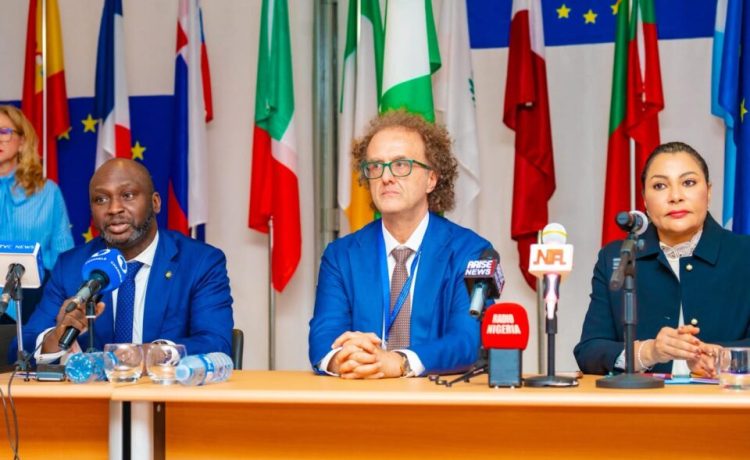
Top officials at the briefing, including Minister of Budget and Economic Planning, Abubakar Bagudu, and the European Union Ambassador to Nigeria, Gautier Mignot, described the agreement as a major boost for sustainable financing and industrial development.
Olusi reaffirmed the broader vision behind the initiative, stressing that Nigeria aims to build globally competitive industries, create jobs at scale, and improve the quality of life for its citizens.