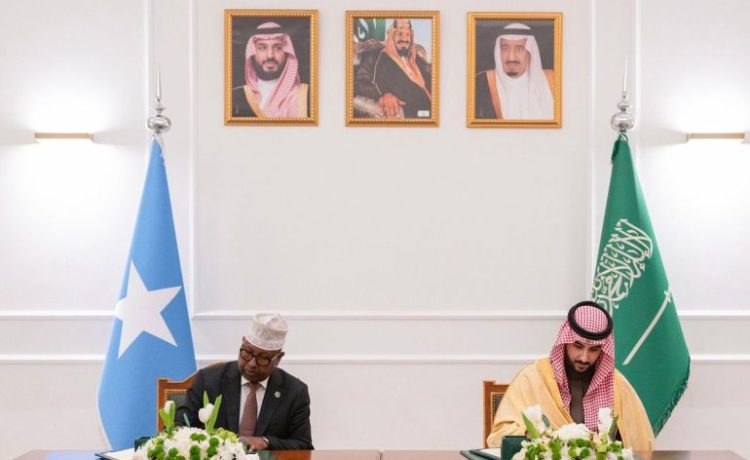
Somalia has signed a new military cooperation agreement with Saudi Arabia, intensifying its diplomatic outreach to Gulf states amid rising regional tensions linked to Israel’s recognition of Somaliland.
The memorandum of understanding was signed in Riyadh on Monday by Somalia’s Defence Minister, Ahmed Moallim Fiqi, and Saudi Arabia’s Defence Minister, Prince Khalid bin Salman bin Abdulaziz. Both countries said the deal would deepen defence and military cooperation, although specific details were not disclosed.
In a statement, Somalia’s Ministry of Defence said the agreement “aims to strengthen the frameworks of defence and military cooperation between the two countries” and covers “multiple areas of common interest that serve the strategic interests of both parties.”
Prince Khalid also confirmed the signing in a post on X, describing the agreement as part of broader efforts to strengthen bilateral relations between Riyadh and Mogadishu.
The pact comes weeks after Somalia signed a similar defence agreement with Qatar, signalling a clear strategic shift towards Gulf partners at a time of growing uncertainty in the Horn of Africa.
According to Somalia’s state news agency, the deal with Doha focuses on military training, exchange of expertise, development of defence capabilities and closer security cooperation. Qatar said the agreement is designed to enhance joint cooperation and strengthen defence partnerships between the two nations.
Together, the agreements reflect a coordinated diplomatic and security push by Mogadishu as it navigates one of its most sensitive foreign policy challenges in years.
The immediate trigger is Israel’s decision in December to recognise Somaliland, a self-declared breakaway region that has operated independently from Somalia since 1991 but lacks broad international recognition. Israel became the first country to formally recognise Somaliland, a move Somalia has strongly condemned as a violation of its sovereignty.
Mogadishu has warned that the recognition could carry serious security implications. Somali officials have accused Israel of planning to establish a military base in Somaliland, although Israel has not confirmed the claim.
Somalia argues that such a base could be used to project power across the Red Sea and threaten neighbouring states.
“This is not just a political issue. It is a direct threat to regional stability,” a senior Somali official told Al Jazeera, speaking on condition of anonymity due to the sensitivity of the matter.
Analysts say Somalia’s outreach to Saudi Arabia and Qatar reflects both urgency and strategic calculation. Gulf states hold significant political and financial influence in the region and have strong interests in Red Sea security, trade routes and counterterrorism efforts.
Saudi Arabia has expanded its security engagement in the Horn of Africa in recent years, driven by maritime security concerns and regional rivalries. Qatar has also maintained close ties with Somalia, providing aid, military training and diplomatic support to successive governments in Mogadishu.
For Somalia, stronger defence ties with Gulf allies could help bolster its armed forces as they continue operations against the Islamist group al Shabaab. It may also strengthen diplomatic backing against actions perceived as threats to its territorial integrity.
However, the lack of detail surrounding the Saudi agreement leaves key questions unanswered. It remains unclear whether the pact will involve troop deployments, arms transfers, intelligence sharing or other forms of direct military cooperation.
What is evident is that Somalia is signalling it will not confront the Somaliland issue alone. By rapidly securing regional partnerships, Mogadishu appears determined to transform diplomatic support into strategic backing as the Horn of Africa once again becomes a focal point of regional and global competition.