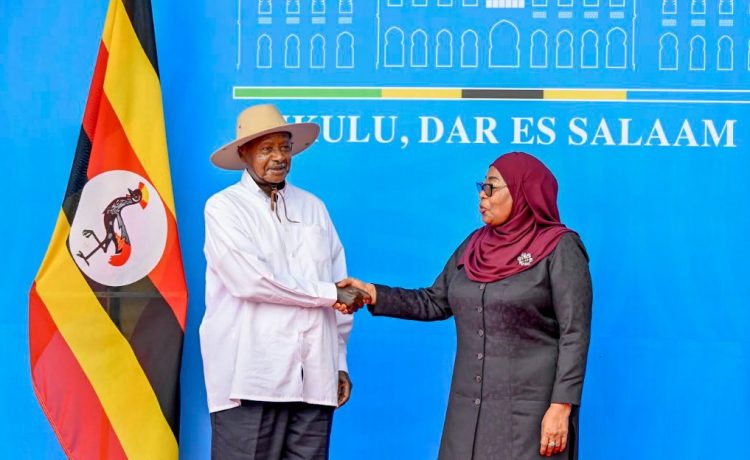
Uganda and Tanzania have announced major cooperation agreements spanning energy, trade, infrastructure, and regional security, following bilateral talks between Presidents Yoweri Kaguta Museveni and Samia Suluhu Hassan.
The leaders made the announcement during a joint press briefing on Monday, after discussions between their respective delegations.
President Samia highlighted progress on key energy projects, including the East African Crude Oil Pipeline (EACOP), which is on track to commence oil transportation in July. Plans also include a gas pipeline from Tanzania to Uganda and a refined oil pipeline from Uganda to the Tanzanian port of Tanga, positioning Tanzania as a critical export corridor for Ugandan petroleum products.
On trade and logistics, the leaders discussed improving Ugandan traders’ access to Tanzanian ports, particularly Tanga and Dar es Salaam, and extending railway connectivity into Uganda to facilitate smoother and more cost-effective cargo movement. Both sides also pledged to remove persistent non-tariff barriers that hinder regional trade.
President Samia further emphasized joint energy production initiatives aimed at meeting domestic needs and supplying regional and international markets. The talks also covered strategies to promote peace and stability in the Great Lakes Region, including dialogue processes to resolve ongoing conflicts.
Welcoming President Museveni to Tanzania, Samia congratulated him and Uganda’s National Resistance Movement (NRM) on their landslide election victory, praising the party’s manifesto and ideological clarity.
President Museveni, in turn, stressed the importance of Africa protecting its independence, generating prosperity through competitive production and trade, and addressing regional security challenges. He noted discussions on industrial specialization, with Tanzania focusing on locomotive manufacturing and Uganda on textile production.
Both leaders reaffirmed their commitment to strengthening bilateral relations, deepening cooperation, and advancing economic resilience and regional stability in East Africa.