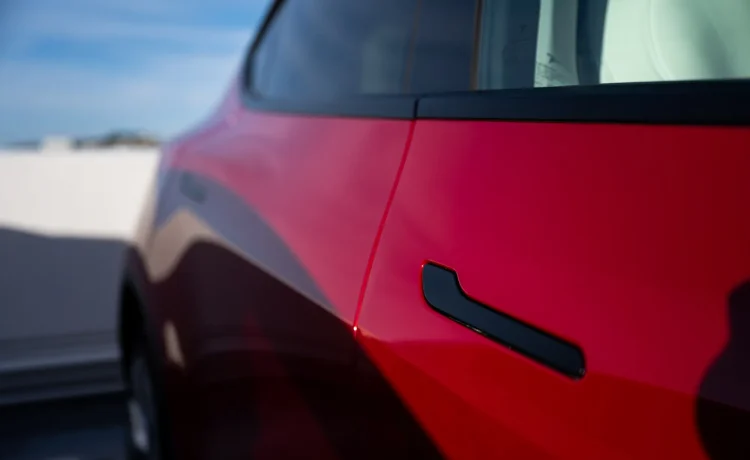
China has become the first country to ban hidden door handles on electric vehicles (EVs), a design popularised by Tesla and other new energy vehicles (NEVs), following safety concerns over several deadly incidents.
The Ministry of Industry and Information Technology announced that cars sold in China must have mechanical releases for doors both inside and outside the vehicle. The new rules will take effect on 1 January 2027. Vehicles already approved for the market will have two years to update their designs.
The regulations specify that the outside of every passenger door, except the boot, must feature a recessed space measuring at least 6cm by 2cm by 2.5cm to access the handle. Inside the car, visible signs of at least 1cm by 0.7cm must indicate how to operate the door.
Hidden handles have been widely adopted in China’s NEV market, which includes EVs, hybrids, and fuel-cell vehicles. They appear on approximately 60% of the top 100 best-selling NEVs, according to China Daily.
The ban follows multiple safety concerns, including two fatal crashes in China involving Xiaomi EVs, in which power failures were suspected to have prevented doors from opening.
Although the rule applies only to the Chinese market, China’s influence on the global auto industry means the policy is expected to have worldwide impact. Tesla’s door handles are already under investigation by the US National Highway Traffic Safety Administration (NHTSA), and European regulators are considering similar measures.
In November 2025, the NHTSA launched a probe into Tesla’s electric-powered door handles following reports of sudden malfunctions that trapped occupants. Of nine complaints received for Tesla Model Y cars from 2021, four owners had to break windows to exit the vehicles safely.
The new Chinese regulations aim to improve passenger safety and ensure reliable access to EVs in emergency situations, potentially influencing global design standards in the rapidly growing electric vehicle market.