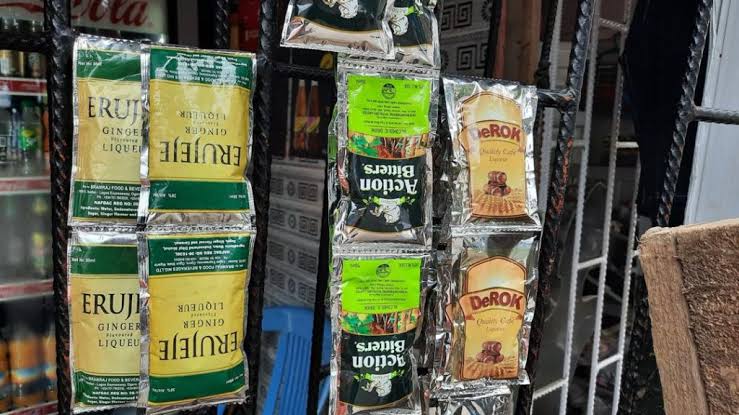
The National Agency for Food and Drug Administration and Control (NAFDAC) has resumed enforcement of the ban on the production and sale of alcoholic beverages packaged in sachets and small plastic or glass bottles below 200 millilitres, citing public health concerns.
The agency clarified that it did not shut down any alcohol-producing companies but only prohibited the sale of alcohol in sachets and small containers. According to NAFDAC, the move is aimed at protecting children, adolescents and young adults from the harmful use of alcohol.
In a statement on Thursday, the Director-General of NAFDAC, Prof. Mojisola Christianah Adeyeye, said the renewed enforcement aligns with a resolution of the Senate and the agency’s public health mandate.
“The National Agency for Food and Drug Administration and Control has resumed enforcement of the ban on the production and sale of alcoholic beverages packaged in sachets and small-volume PET or glass bottles below 200ml, in line with a resolution of the Senate of the Federal Republic of Nigeria and the Agency’s public health mandate,” the statement read.
NAFDAC explained that the widespread availability of high-alcohol-content drinks in sachets and small containers has made alcohol cheap, easily accessible and easily concealable, contributing to rising cases of underage drinking, addiction, domestic violence, road accidents, school dropouts and other social vices.
Adeyeye noted that warning labels such as “Not for children” have proven ineffective in addressing the problem.
“Many parents do not even know their children consume sachet alcohol because the pack size is small, cheap and easily concealed,” she said.
She added that reports from schools have revealed troubling trends, including a recent case where a student reportedly said he could not sit for an examination without first taking sachet alcohol.
NAFDAC recalled that in December 2018, the agency, alongside the Federal Ministry of Health and Social Welfare and the Federal Competition and Consumer Protection Commission (FCCPC), signed a five-year Memorandum of Understanding with manufacturers to phase out sachet and small-volume alcohol packaging by January 31, 2024. The moratorium was later extended to December 2025 to allow producers to exhaust existing stock and adjust their production lines.
According to Adeyeye, the renewed enforcement is consistent with Nigeria’s commitment to the World Health Assembly’s Global Strategy to Reduce the Harmful Use of Alcohol.
“This ban is not punitive; it is protective. It is aimed at safeguarding the health and future of our children and youth by not allowing alcohol in small pack sizes,” she said.
She stressed that the decision was based on scientific evidence and public health considerations, adding that only spirit drinks packaged below 200ml are affected, while alcoholic beverages in larger pack sizes remain approved by NAFDAC.
The enforcement has, however, triggered strong reactions from industry and labour groups. The Manufacturers Association of Nigeria, along with other stakeholders including the Food and Beverage Tobacco Outgrowers and Bottlers (FOBTOB), criticised the move, describing it as inconsistent and potentially damaging to the economy.
On January 23, members of the Distillers and Blenders Association of Nigeria, the Nigerian Labour Congress and the Trade Union Congress protested at NAFDAC’s Lagos office, warning that the ban could lead to the loss of up to 5.5 million jobs.
Some protesters described the policy as a regulatory misstep that fails to balance public health objectives with economic realities, especially in a country where low-cost sachet spirits are widely consumed by low-income earners.
Despite the backlash, NAFDAC urged manufacturers, distributors and retailers to comply fully with the directive, stressing that no further extension would be granted beyond December 2025.
The agency said it would continue to work with the Federal Ministry of Health and Social Welfare, the FCCPC and the National Orientation Agency to intensify nationwide sensitisation on the dangers of alcohol misuse.
NAFDAC reaffirmed its commitment to ensuring that only safe, wholesome and properly regulated products are available to Nigerians.