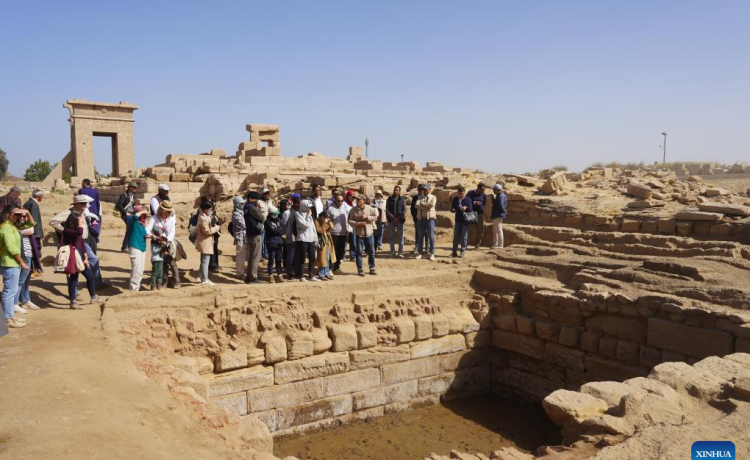
An Egyptian-Chinese archaeological mission has announced the discovery of an ancient “sacred lake” at the Montu Temple precinct within the Karnak Temple Complex in Luxor, southern Egypt.
The newly uncovered lake, covering over 50 square meters, is located west of the Maat Temple—dedicated to the goddess of harmony, justice, and truth—and forms a unique north-south alignment with a previously known sacred lake within the Montu Temple enclosure.
Termed the Southern Sacred Lake, the discovery represents the only sacred lake in Egyptian archaeology to undergo systematic scientific excavation, according to Jia Xiaobing, the Chinese head of the project. Sacred lakes were an essential part of ancient Egyptian temple architecture, providing holy water exclusively for ritual use, distinct from domestic supplies.
“This new find is the only sacred lake in the history of Egyptian archaeology that has undergone systematic and scientific excavation, providing a wealth of first-hand materials for research, especially studies of sacred lakes,” Jia said.
Hend Aly, a senior inspector at the Montu Temple and Egyptian member of the mission, described the discovery as the culmination of eight years of painstaking work. Using advanced technological methods, the team cleared sand and debris to reveal the well-preserved man-made water reservoir.
Due to groundwater limitations, the foundational structure and initial construction date of the lake are yet to be fully determined.
Beyond the lake, excavations in the Osirian chapel area uncovered three chapels dedicated to Osiris, dozens of Osiris statuettes in varying sizes and materials, and fragments associated with the Divine Adoratrice of Amun—a priestess title held by royal women during the 25th and 26th Dynasties. Archaeologists also found dozens of cow jaw remains and reused stone blocks linked to kings and divine adoratrices from the Late Period (747–332 BC).
The findings offer new evidence to reconstruct the history of Thebes under the rule of the Divine Adoratrice, deepening understanding of ritual practices and temple life.
The Montu Temple site spans roughly 106,000 square meters, with 24,000 square meters inside the temple precinct. Since 2018, the joint mission, a collaboration between Egypt’s Ministry of Tourism and Antiquities and the Institute of Archaeology of the Chinese Academy of Social Sciences, has excavated around 2,300 square meters of the site.
The project has also received support from the Zhengzhou Municipal Institute of Cultural Relics and Archaeology and the Institute of World History of the Chinese Academy of Social Sciences.