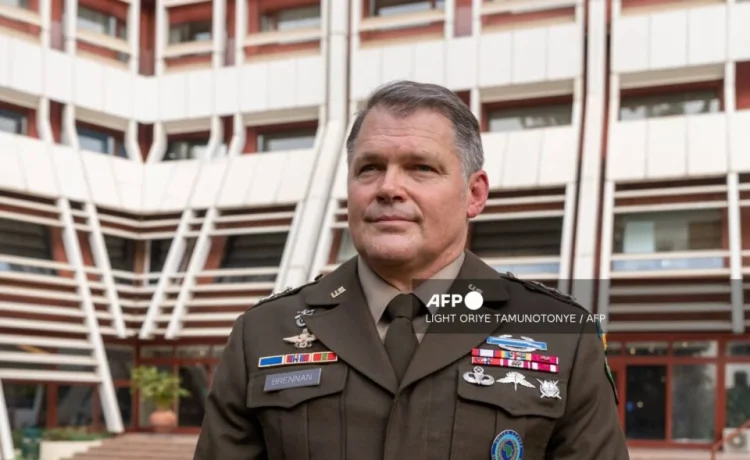
The United States military is increasing materiel deliveries and intelligence sharing with Nigeria as part of a broader effort to combat Islamic State-linked militants across Africa, according to the deputy commander of US Africa Command (Africom).
Lieutenant General John Brennan disclosed the development in an interview with AFP, saying the enhanced cooperation with Abuja reflects Washington’s push to work more closely with African militaries while adopting a tougher stance against extremist groups on the continent.
The move follows recent US diplomatic pressure on Nigeria over persistent jihadist violence, as well as a shift under the Trump administration toward more aggressive military action against Islamic State-linked targets.
“Under the Trump administration, we’ve gotten a lot more aggressive and (are) working with partners to target, kinetically, the threats, mainly ISIS,” Brennan said on the sidelines of a US–Nigeria Joint Working Group security meeting held in Abuja last week.
“From Somalia to Nigeria, the problem set is connected. So we’re trying to take it apart and then provide partners with the information they need,” he added.
Brennan said the US focus has been on enabling partner forces by providing equipment, intelligence and operational capabilities with fewer restrictions to improve effectiveness on the battlefield.
The renewed cooperation comes about a month after the United States carried out surprise Christmas Day air strikes on Islamic State-linked targets in northwestern Nigeria, an operation that marked a rare direct US military action inside the country.
While both militaries appear keen to deepen collaboration following the joint strikes, the relationship is complicated by Washington’s claims—repeated by President Donald Trump—that Christians are being mass-killed in Nigeria. Nigerian authorities and independent analysts have rejected this framing, arguing that the country’s security crisis is driven by complex, overlapping conflicts rather than religious persecution.
The issue surfaced during the Abuja meeting when Allison Hooker, a senior US State Department official, urged Nigeria to “protect Christians” in a speech that did not reference Muslim victims of armed groups.
Nigeria, Africa’s most populous country, is roughly evenly divided between a predominantly Muslim north and a largely Christian south. While many communities coexist peacefully, religious and ethnic identity remain sensitive issues amid a long history of sectarian violence.
Brennan stressed that US intelligence support would not be limited to protecting any single religious group.
Following the strikes in Sokoto State, he said future US assistance would focus heavily on intelligence sharing to support Nigerian air operations in the northwest and in the northeast, where Boko Haram and its Islamic State-aligned offshoot, the Islamic State West Africa Province (ISWAP), have waged an insurgency since 2009.
“ISWAP is our most concerning group,” Brennan said.
US intelligence flights over Nigeria have reportedly increased in recent months, though analysts caution that air power alone may be insufficient to defeat militant groups operating in areas marked by poverty, weak governance and limited state presence.
According to Brennan, future cooperation will cover “the whole gamut of intel sharing, tactics, techniques and procedures,” as well as helping Nigeria procure additional military equipment.
The initial US strikes targeted fighters linked to Islamic State Sahel Province (ISSP), a group more commonly active in Niger but increasingly seen as a threat to Nigeria and other coastal West African states.
The impact of those strikes remains unclear, with journalists unable to independently confirm militant casualties. Nigeria’s Minister of Information, Mohammed Idris, described the operation last week as “still a work in progress.”
Beyond Nigeria, Brennan said the US has maintained informal communication with militaries in the junta-led Sahel countries of Burkina Faso, Mali and Niger, despite a cooling of official relations following a series of coups between 2020 and 2023.
“We still collaborate,” he said. “We have actually shared information with some of them to attack key terrorist targets, even though it’s not official.”
Brennan also ruled out the establishment of new US military bases in the region following the closure of American drone operations in Agadez, Niger.
“We’re not in the market to create a drone base anywhere,” he said. “We’re much more focused on getting capability to the right place at the right time and then leaving.”